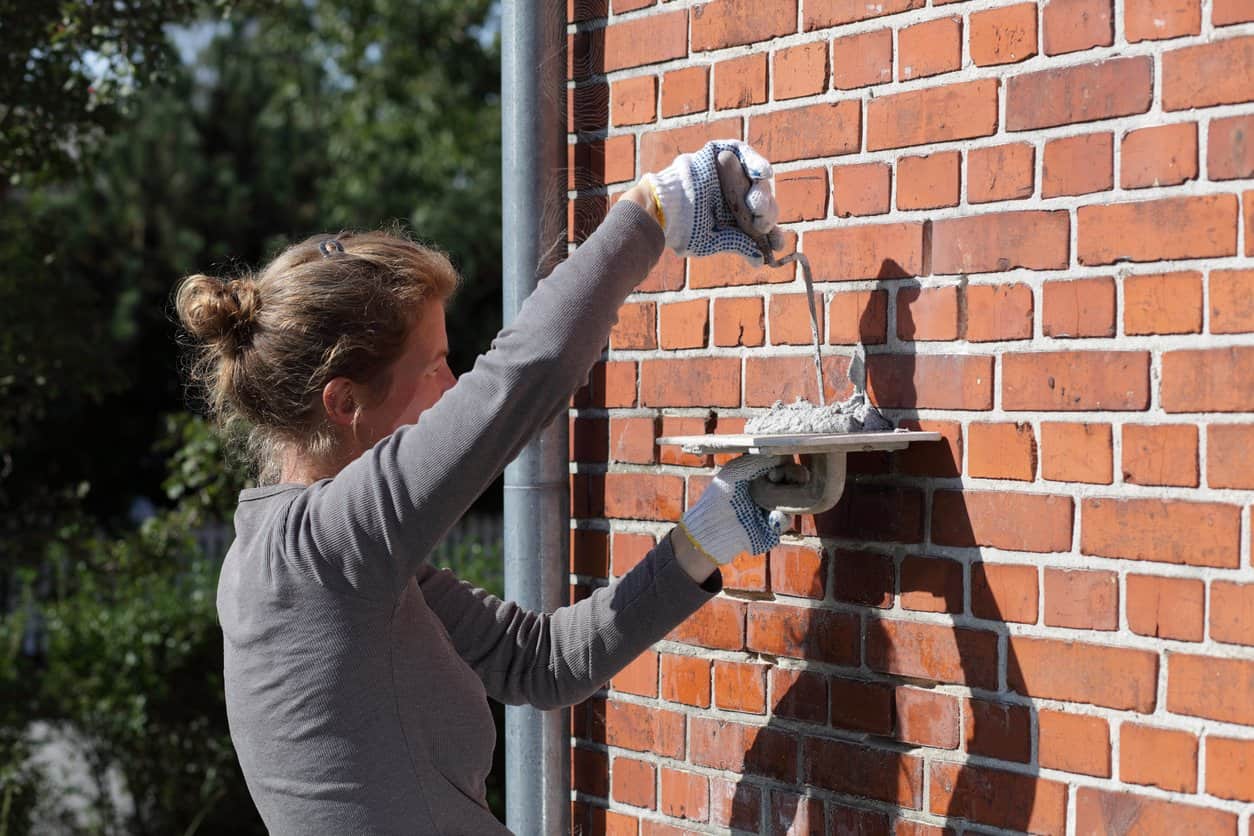
Brick masonry is generally low maintenance, but it is not maintenance-free.
The most effective way to maintain brick is to inspect the complete wall system periodically, manage water before it enters the masonry, clean only when necessary, and repair deteriorated mortar, sealant joints, flashing, or damaged bricks with materials compatible with the existing construction.
Most brick walls do not need routine waterproofing, yearly chemical cleaning, or quick caulk patches.
The correct maintenance depends on whether the masonry is:
- Brick veneer
- A solid or mass masonry wall
- A chimney
- A retaining or garden wall
- A foundation
- Brick paving
- Historic masonry
Kelly Masonry evaluates brick condition, mortar, cracks, moisture, flashing, drainage, and previous repairs through our brick and stone repair services.
Brick Maintenance at a Glance
| Maintenance question | Direct answer |
|---|---|
| How often should brick be inspected? | Periodically and after severe weather, leaks, movement, or nearby construction |
| Does brick need annual cleaning? | No. Clean when dirt, stains, salts, or biological growth justify it |
| Should every brick wall be sealed? | No. Correct drainage, flashing, mortar, brick, and sealant defects first |
| Can brick be pressure washed? | Sometimes at controlled pressure after testing, but aggressive washing can damage brick and mortar |
| Can cracks be filled with caulk? | Some designed sealant joints use elastomeric sealant, but mortar or brick cracks should not automatically be caulked |
| What is efflorescence? | Salt deposited as moisture moves through masonry and evaporates |
| When is repointing needed? | When mortar is cracked, loose, crumbling, missing, deeply eroded, or separated from the brick |
| Is the strongest mortar best? | No. Replacement mortar must be compatible with the brick and original mortar |
| What causes brick spalling? | Possible causes include moisture, freezing, incompatible mortar, coatings, salts, or defective details |
| When should a professional inspect the wall? | When bricks are loose, cracked, spalling, bulging, displaced, leaking, or affected by patterned cracks |
1. Inspect the Complete Brick Wall
Maintenance should begin with an inspection—not a cleaner, sealant, or bag of mortar.
Walk around the property from the ground and photograph each wall elevation. Do not climb onto roofs, chimneys, or unstable structures to conduct a homeowner inspection.
Look for:
- Cracked bricks
- Loose or displaced bricks
- Spalled or flaking brick faces
- Crumbling mortar
- Missing mortar
- Cracks between brick and mortar
- Stair-step or diagonal cracks
- Horizontal cracks
- Bulging or leaning areas
- White deposits
- Dark moisture staining
- Biological growth
- Rust staining
- Failed sealant around windows and doors
- Missing or clogged weeps
- Interior staining or dampness
- Changes since the previous inspection
The Brick Industry Association’s maintenance guide recommends periodic inspections and documentation with photographs and notes.
Create a simple maintenance record
Record:
- Inspection date
- Wall location
- Approximate crack width and length
- Weather conditions
- Whether the condition changes after rain
- Previous repairs
- Cleaning or coating products used
- Before-and-after photographs
These records help determine whether a crack is stable, growing, recurring, or related to weather.
2. Control Water Before Treating the Brick
Many apparent brick problems begin with water management.
Inspect:
Gutters and downspouts
Look for:
- Overflowing gutters
- Leaking joints
- Missing downspout sections
- Water discharging beside the foundation
- Downspouts aimed at brick walls
- Concentrated roof runoff
Flashing
Flashing directs water out of wall, roof, chimney, window, and door assemblies.
Damaged or missing flashing can allow water behind otherwise sound-looking brick.
Common locations include:
- Chimneys
- Roof-to-wall intersections
- Windows
- Doors
- Sills
- Lintels
- Parapets
- Wall bases
Caps, crowns, copings, and sills
These horizontal or sloped elements should shed water away from masonry.
Inspect for:
- Cracks
- Open joints
- Insufficient slope
- Missing drip edges
- Failed sealant
- Water collecting on top
Weeps
Many brick-veneer and cavity-wall systems include openings that allow water to drain from behind the exterior brick.
Do not fill or seal weeps simply because they appear to be holes.
Potential concerns include:
- Mortar blocking the opening
- Paint or coating covering it
- Landscaping obstructing it
- Insect screens or inserts that prevent drainage
- Missing weeps where the wall assembly requires them
Cleaning or altering weeps should be performed carefully so the flashing behind them is not damaged.
Grading and irrigation
Check whether soil, mulch, sprinklers, or hardscaping repeatedly wet the wall.
Water should not continually collect at:
- Foundations
- Brick steps
- Retaining walls
- Basement windows
- Porch walls
- Chimney bases
Read our guide to yard drainage problems and solutions when runoff or grading affects the masonry.
3. Clean Brick Only When Necessary
Brick does not need to be aggressively cleaned on a fixed annual schedule.
Clean when there is a specific reason, such as:
- Dirt accumulation
- Moss, algae, or lichen
- Efflorescence
- Mortar smears
- Rust
- Paint
- Organic staining
- Pollution or atmospheric deposits
Before selecting a cleaner:
- Identify the type of brick.
- Identify the mortar.
- Determine the stain.
- Check for previous coatings.
- Inspect for open joints and damaged units.
- Test the gentlest suitable method in a small, inconspicuous area.
- Allow the test area to dry completely before judging it.
The Brick Industry Association’s cleaning guidance recommends beginning with the gentlest suitable method and testing cleaning products and procedures before treating the full area.
A basic low-risk starting method
For light surface dirt on sound modern brick:
- Remove loose debris
- Use clean water
- Use a soft or suitable nonmetallic bristle brush
- Work on a small area
- Avoid forcing water into open joints
- Rinse as required
- Allow the wall to dry
- Check for color, texture, or mortar changes
This is only a starting point. Some stains require product-specific treatment.
4. Avoid Aggressive Cleaning Methods
Improper cleaning can permanently alter brick and mortar.
Use caution with:
- Sandblasting
- Abrasive blasting
- Wire brushes
- Grinding or sanding brick faces
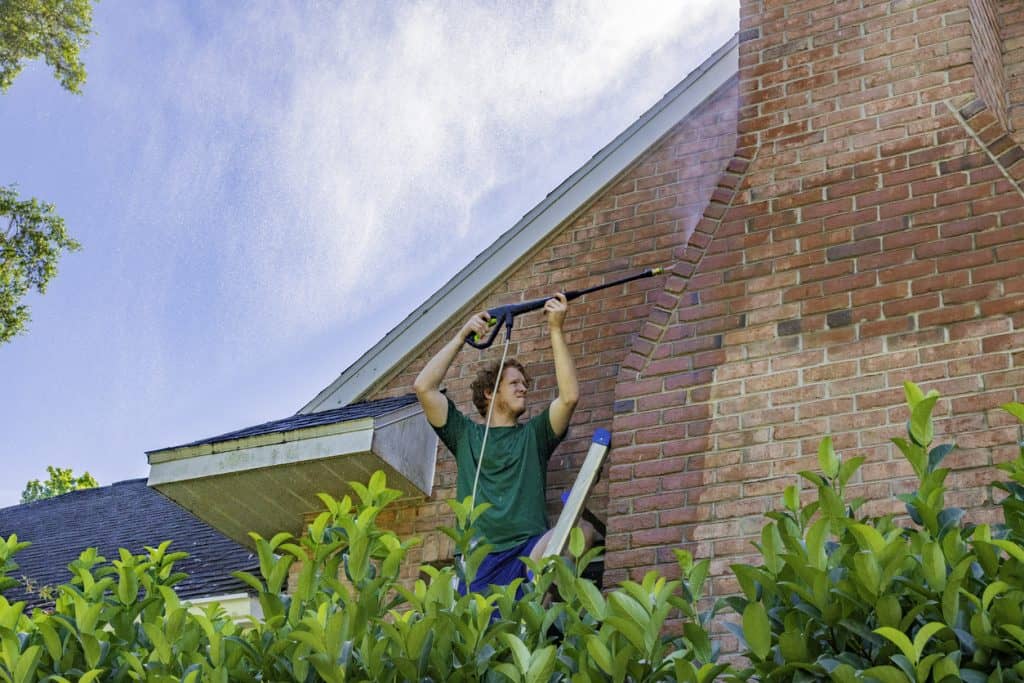
- Uncontrolled pressure washing
- Concentrated acids
- Household chemicals not approved for masonry
- Mixing cleaning products
- Cleaning without prewetting or rinsing when required
Aggressive cleaning may:
- Remove the fired outer surface of brick
- Etch mortar
- Widen joints
- Increase water absorption
- Leave permanent discoloration
- Force water into the wall
- Expose softer interior material
- Damage historic masonry
The National Park Service recommends using the gentlest effective cleaning method and warns that abrasive cleaning can cause physical and aesthetic damage to historic building materials.
5. Can Brick Be Pressure Washed?
Pressure washing is not automatically prohibited, but it should not be treated as a universal brick-cleaning method.
The risk depends on:
- Brick hardness
- Mortar condition
- Wall age
- Water pressure
- Nozzle
- Distance
- Spray direction
- Duration
- Existing cracks
- Interior moisture sensitivity
- Previous coatings
High-pressure water directed into mortar joints can remove mortar, drive water into the wall, or damage softer brick.
Historic, painted, spalled, cracked, or weak masonry requires particular care.
A contractor should perform a test area and explain:
- Proposed pressure
- Nozzle and distance
- Cleaning solution
- Protection of openings and landscaping
- Water-control plan
- How damaged joints will be protected
- How the result will be evaluated after drying
6. Understand Efflorescence Before Removing It
Efflorescence is a white or light-colored salt deposit that appears when moisture moves through masonry and evaporates.
The deposit itself is often primarily a surface condition, but recurring efflorescence can indicate ongoing moisture movement.
Possible moisture sources include:
- Leaking gutters or downspouts
- Missing flashing
- Failed caps or crowns
- Open mortar joints
- Groundwater
- Irrigation
- Poor grading
- Plumbing leaks
- Construction moisture
- Water trapped behind a coating
How should efflorescence be removed?
Begin by allowing the wall to dry and using a dry, nonmetallic brush where appropriate.
More persistent deposits may require a cleaner formulated for the specific brick and condition.
Do not assume that vinegar, muriatic acid, or another household treatment is safe for every brick wall. Acidic cleaners can react with masonry, mortar, pigments, metals, and previous coatings.
Correct the moisture source before repeatedly cleaning the visible salt.
7. Do Not Automatically Waterproof or Seal Brick
Most sound brick walls do not need routine waterproofing.
Brick walls commonly manage water through a combination of:
- Brick and mortar
- Wall cavities
- Flashing
- Weeps
- Sealant joints
- Caps and copings
- Roof overhangs
- Drainage
- Drying
A coating cannot replace these details.
The Brick Industry Association’s guidance on colorless coatings recommends correcting water-penetration defects before considering a water repellent.
Sealant and water repellent are different
Sealant is used in designed joints between different materials or at movement locations, such as around windows, doors, copings, and expansion joints.
Water repellent is a penetrating treatment intended to reduce water absorption.
Waterproof coating usually forms a more continuous barrier and can greatly change how a wall dries.
These treatments are not interchangeable.
When might a water repellent be considered?
A breathable, masonry-compatible water repellent may sometimes be considered for particularly exposed masonry, such as selected chimneys or parapets, after:
- The moisture source has been identified.
- Flashing, caps, mortar, brick, and sealant defects have been repaired.
- The wall has been allowed to dry.
- The product is confirmed as compatible.
- A test area is completed.
- The risks and maintenance requirements are understood.
Do not apply a generic film-forming sealer to an old brick wall merely because brick is porous.
8. Inspect Mortar Joints
Mortar joints are intended to work with the surrounding brick.
Look for:
- Crumbling
- Powdering
- Deep erosion
- Missing sections
- Cracks
- Voids
- Separation from brick edges
- Previous hard cement patches
- Broad mortar smears covering brick faces
Not every shallow imperfection requires immediate repointing. The location, depth, wall type, exposure, moisture, and surrounding brick condition should be evaluated together.
What is repointing?
Repointing is the removal of deteriorated mortar from masonry joints and its replacement with compatible new mortar.
It is not simply:
- Smearing mortar over the surface
- Filling joints with caulk
- Painting over cracks
- Installing the strongest available cement
- Covering movement without investigation
Read our complete guide to brick and stone repointing.
9. Use Compatible Repointing Mortar
Replacement mortar should be physically and visually compatible with the existing wall.
Important properties include:
- Strength
- Flexibility
- Vapor permeability
- Bond
- Water retention
- Sand grading
- Color
- Texture
- Joint profile
Mortar that is too hard or dense can concentrate stress and moisture in softer brick, contributing to cracked or spalled brick faces.
Historic masonry may require evaluation of:
- Original mortar
- Lime content
- Sand
- Building age
- Brick hardness
- Previous cement repairs
- Historic joint profile
- Moisture behavior
The National Park Service’s repointing guidance explains that improper repointing can damage masonry and that deterioration sources such as leaking gutters should be corrected before new mortar is installed.
10. Do Not Treat Every Crack the Same Way
Cracks can occur in:
- Mortar joints
- Brick units
- Sealant joints
- Wall transitions
- Foundations
- Lintels
- Chimneys
- Parapets
The repair depends on the cause.
A small crack may still require diagnosis
A narrow crack may result from:
- Drying shrinkage
- Thermal movement
- Settlement
- Rusting steel
- Foundation movement
- Inadequate movement joints
- Failed lintels
- Water and freezing
- Previous incompatible repairs
Applying masonry caulk to every visible crack can conceal movement, create an incompatible appearance, or delay the correct repair.
Seek professional evaluation when you see:
- Stair-step cracks
- Diagonal cracks
- Horizontal cracks
- Cracks continuing through bricks
- Repeated cracks through previous repairs
- Separation around windows or doors
- Bulging or leaning masonry
- Displaced brick
- Rust staining near steel lintels
- Multiple spalled bricks
- Rapid change
Structural movement should not be diagnosed remotely from a photograph alone. Learn more about structural masonry repairs.
11. Replace Severely Damaged Bricks When Necessary
Repointing replaces mortar, not damaged masonry units.
A brick may require replacement when it is:
- Deeply spalled
- Cracked through the unit
- Loose
- Displaced
- Structurally damaged
- Severely deteriorated
- Incompatible with a previous repair
Replacement brick should be matched for:
- Size
- Color range
- Texture
- Absorption
- Strength
- Exposure rating
A perfect visual match may not always be available, particularly on older homes. A sample panel can help evaluate the proposed brick and mortar before broader repairs begin.
12. Pay Extra Attention to Chimneys
Brick chimneys experience severe exposure because they extend above the roof and receive wind-driven rain, snow, freezing, and temperature changes.
Inspect:
- Crown
- Cap
- Flue covering
- Flashing
- Counterflashing
- Mortar joints
- Brick faces
- Roof intersection
- Interior staining
- Attic staining
- Firebox moisture
A leaking chimney should not automatically be treated by coating the brick. The source may involve the cap, crown, flashing, mortar, brick, roofing, or condensation.
Read why brick chimneys leak or explore Kelly Masonry’s chimney repair services.
13. Remove Plant Growth Carefully
Ivy and other climbing plants can enter mortar voids or conceal deterioration.
Do not pull firmly attached vines directly from weak or historic masonry.
A careful process may involve:
- Cutting the vines
- Allowing attached growth to dry
- Removing it gradually
- Inspecting the exposed wall
- Repairing damaged mortar
- Correcting moisture and vegetation conditions
Test a small area first because removing mature growth may reveal staining, missing mortar, or damaged brick.
14. Maintain Brick Paving Differently
Brick patios and walkways do not always use the same maintenance system as vertical walls.
A sand-set clay-brick patio may require:
- Sweeping
- Joint-sand inspection
- Weed and organic-debris removal
- Edge-restraint inspection
- Resetting settled units
- Controlled cleaning
A mortar-set brick surface may require:
- Mortar-joint inspection
- Crack evaluation
- Drainage inspection
- Selective repointing
- Repair of loose or spalled units
Do not repoint a sand-set patio as though it contains mortared joints.
Aggressive pressure washing can remove joint sand and destabilize brick paving.
Seasonal Brick Maintenance Checklist
Spring
- Check for damage after winter
- Inspect mortar and brick faces
- Look for efflorescence
- Check chimney crown and visible flashing
- Confirm downspouts discharge appropriately
- Photograph cracks for comparison
Summer
- Complete suitable repairs
- Clean only where needed
- Trim vegetation
- Evaluate biological growth
- Inspect irrigation overspray
Fall
- Clean gutters and drains
- Remove leaves from brick paving
- Check caps, crowns, and sealant joints
- Prepare drainage for winter
- Correct water collecting near masonry
Winter
- Monitor leaks and ice formation
- Avoid impact damage during snow removal
- Use deicing products compatible with the exact brick or paving product
- Do not install mortar in unsuitable weather without a proper cold-weather plan
This checklist is a planning tool rather than a universal maintenance schedule.
When to Call a Mason
Contact a qualified masonry professional when:
- Mortar is extensively deteriorated
- Bricks are loose or spalling
- Cracks follow a pattern
- The wall is bulging or leaning
- Water repeatedly enters the building
- Efflorescence returns after cleaning
- Chimney masonry is deteriorated
- Historic brick needs repointing
- Previous repairs are failing
- Cleaning may involve paint, acids, or fragile masonry
- A coating is being considered
- Matching brick or mortar is required
Kelly Masonry can determine whether the correct next step is:
- Cleaning
- Repointing
- Brick replacement
- Sealant replacement
- Flashing or chimney repair
- Drainage correction
- Structural evaluation
- Monitoring without immediate repair
How Much Does Brick Maintenance or Repair Cost?
Cost depends on:
- Inspection findings
- Wall height
- Access
- Scaffolding
- Cleaning method
- Mortar condition
- Number of damaged bricks
- Mortar matching
- Historic requirements
- Flashing
- Chimney work
- Structural movement
- Water-source correction
- Size of the affected area
Kelly Masonry’s brick and stone repair planning ranges begin around $5,000 for localized repairs, with larger restoration projects commonly ranging from $10,000 to $25,000. Actual pricing depends on the damage, access, materials, moisture conditions, and repair scope.
These are planning levels rather than fixed prices.
Review our complete brick and masonry repair cost guide and current project pricing.
Frequently Asked Questions
How often should brick masonry be inspected?
Inspect it periodically and after severe storms, leaks, nearby excavation, impact, or visible movement. More exposed elements such as chimneys, parapets, and retaining walls may need closer attention.
How often should brick be cleaned?
There is no fixed schedule. Clean only when dirt, staining, salts, or biological growth justifies treatment.
Should I seal my brick house?
Not automatically. Correct flashing, caps, gutters, mortar, brick, sealant joints, weeps, and drainage problems first. A compatible water repellent may be appropriate only in selected conditions.
Can I pressure wash brick?
Sometimes at controlled pressure after testing. Aggressive pressure washing can damage mortar, soft brick, historic surfaces, and sand-filled paving joints.
Can vinegar remove efflorescence?
Vinegar should not be treated as a universal brick cleaner. Begin with dry brushing where appropriate and use a product selected for the exact brick and deposit if further cleaning is needed.
What causes white stains on brick?
White powdery deposits are commonly efflorescence caused by moisture transporting soluble salts to the surface. Recurring deposits can indicate continuing moisture movement.
How do I know whether mortar needs repointing?
Possible signs include crumbling, missing, deeply eroded, cracked, or separated mortar. The surrounding brick and source of deterioration should also be evaluated.
Can I fill a mortar crack with caulk?
Do not automatically caulk mortar cracks. Caulk is appropriate for certain designed sealant joints, while damaged mortar usually requires diagnosis and a compatible masonry repair.
What is spalling brick?
Spalling is the breaking, flaking, or loss of part of a brick face. Possible causes include moisture, freezing, salts, incompatible mortar, coatings, or physical damage.
Does repointing make a wall structurally sound?
Repointing restores deteriorated mortar joints. It does not correct settlement, bowing, failed lintels, displacement, or other structural movement.
Is mold growing on my brick?
Dark or green surface growth may be algae, moss, lichen, dirt, or another biological deposit. Identify the growth and moisture condition before choosing a treatment.
Can damaged brick be repaired without replacement?
Minor surface conditions may be repairable, but deeply spalled, loose, cracked, or structurally damaged bricks may require replacement.
About the Author
John Kelly is the founder of Kelly Masonry and has more than 25 years of masonry experience. Kelly Masonry has served homeowners throughout Delaware County, the Main Line, and surrounding Pennsylvania communities since 2002.
Originally published: March 23, 2022
Reviewed by: John Kelly
Last updated: July 30, 2026
Does Your Brick Need Maintenance or Repair?
Kelly Masonry can inspect the brick, mortar, cracks, moisture, chimney details, flashing, drainage, and previous repairs before recommending the appropriate work.
Explore our brick and stone repair services, review our masonry maintenance plans, browse our completed restoration projects, or request a consultation.