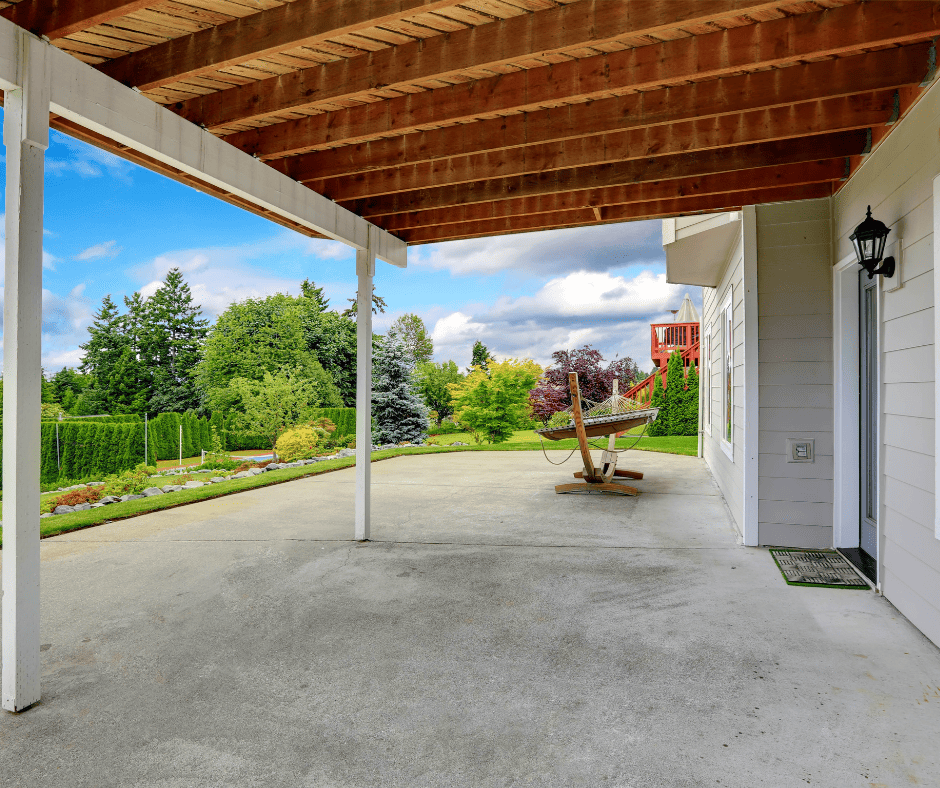

Paver lights are low-profile outdoor fixtures installed within or beside patios, walkways, steps, sitting walls, and driveways. They can improve nighttime visibility, define changes in elevation, and add subtle accent lighting to an outdoor living space.
A dependable paver-light installation requires more than placing lights between paving units. The fixtures must be rated for the location and expected traffic, integrated into a stable hardscape, connected to a compatible power system, and positioned to provide useful light without creating excessive glare.
This guide explains paver-light types, costs, design considerations, transformer planning, installation, maintenance, and the difference between adding lights to a new patio and retrofitting an existing surface.
Kelly Masonry designs and installs custom landscape lighting systems throughout Delaware County, the Main Line, and surrounding Pennsylvania communities.
Paver Lights at a Glance
| Question | Direct answer |
|---|---|
| What are paver lights? | Low-profile fixtures installed within or alongside masonry and hardscape surfaces |
| Where can they be used? | Patios, walkways, steps, sitting walls, driveway borders, pool-adjacent areas, and landscape edges |
| Are most paver lights LED? | Yes, many current paver-light systems use energy-efficient LEDs |
| Are all paver lights safe for driveways? | No. A driveway fixture needs a manufacturer-confirmed load or drive-over rating |
| Are paver lights waterproof? | Some are rated for wet or submerged conditions, but ratings vary by product |
| Is low voltage the same as solar? | No. Low-voltage fixtures use a transformer and cable; solar fixtures use individual solar panels and batteries |
| Can lights be added to an existing patio? | Often, but the paving, base, cable route, drainage, and service access must be evaluated |
| How much does professional lighting cost? | Kelly Masonry landscape-lighting packages generally begin around $5,000, with larger systems around $10,000 and extensive projects reaching $20,000 or more |
What Are Paver Lights?
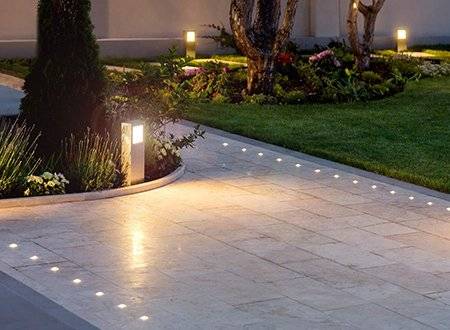
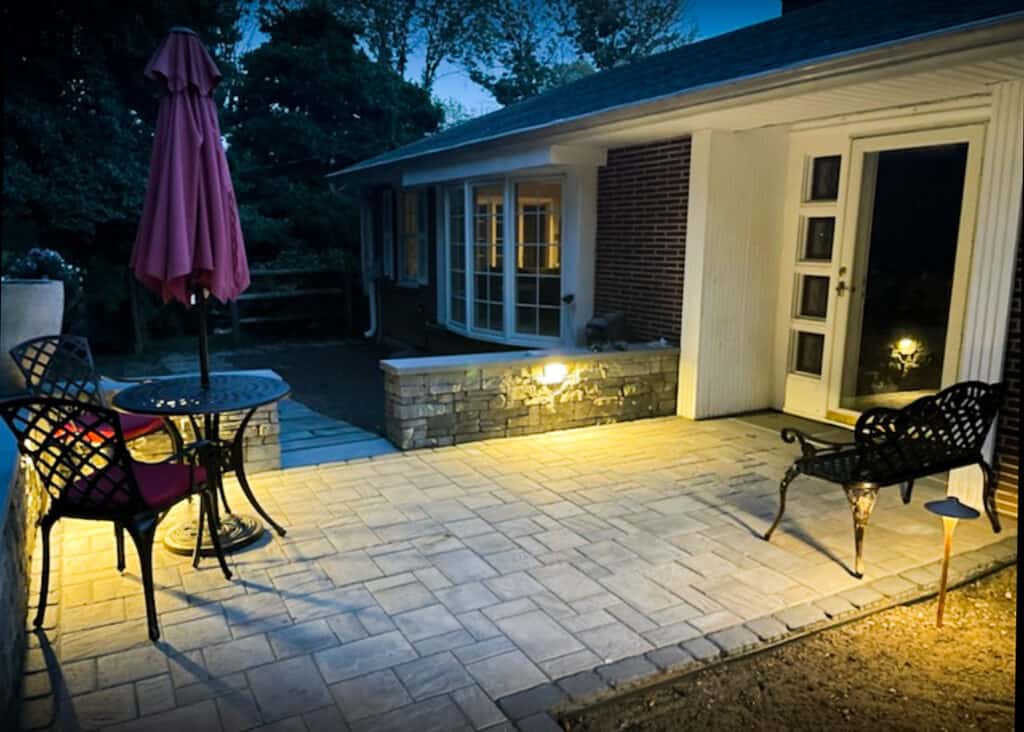
Paver lights are outdoor luminaires designed to integrate with a paved or masonry surface.
Depending on the product, the fixture may be:
- Installed in place of part of a paving unit
- Mounted within a prepared paver or stone
- Installed along a paver border
- Recessed into a step or wall
- Installed flush with a driveway or walkway
- Positioned beside the hardscape rather than directly inside it
The term describes the fixture’s relationship to the paving. It does not identify one power source, light technology, load rating, or installation system.
A paver light may be LED, low voltage, solar-powered, color-changing, pedestrian-rated, or drive-over-rated. Those are separate characteristics that must be evaluated together.
What Are the Benefits of Paver Lighting?
Improved nighttime visibility
Paver lights can help identify walkway edges, steps, elevation changes, driveway boundaries, and transitions between outdoor areas.
They should supplement—not replace—the amount of lighting needed to safely use a space. A few decorative points of light may define an edge without providing enough illumination for cooking, stairs, or other detailed activities.
Subtle integration
A low-profile fixture can become part of the patio, walkway, step, or wall rather than appearing as a separate object within the landscape.
Accent lighting
Paver lights can highlight:
- Walkway curves
- Sitting walls
- Outdoor kitchens
- Patio borders
- Steps
- Columns
- Fire-feature areas
- Water features
- Architectural details
Energy-efficient operation
Many paver-light systems use LEDs, which generally consume less electricity and require less frequent lamp replacement than older incandescent landscape-lighting technology.
Automated control
Compatible systems may use:
- Photocells
- Timers
- Smart controls
- Lighting zones
- Dimming
- Color control
Control compatibility depends on the fixtures, transformer, controller, and complete system design.
Paver Lights vs. In-Ground Lights vs. Hardscape Lights
These terms overlap, but they are not always interchangeable.
| Fixture term | Typical installation | Common use |
|---|---|---|
| Paver light | Integrated into or beside a paving surface | Patio borders, walks, steps, and driveway edges |
| In-ground or well light | Recessed into soil, gravel, concrete, or paving | Uplighting trees, walls, columns, and architectural features |
| Hardscape light | Mounted beneath a cap, tread, ledge, or wall component | Sitting walls, steps, retaining walls, and outdoor kitchens |
| Step light | Installed within a stair riser or nearby wall | Illuminating steps and elevation changes |
| Path light | Mounted above grade on a stem or post | Providing broader illumination along a walkway |
A successful lighting plan often combines several fixture types rather than relying entirely on paver lights.
Solar vs. Low-Voltage Paver Lights
| Factor | Solar paver lights | Low-voltage paver lights |
|---|---|---|
| Power source | Individual solar panel and rechargeable battery | Transformer connected to outdoor-rated low-voltage cable |
| Wiring | Usually no shared cable | Requires planned cable routes and connections |
| Performance | Depends on sunlight, battery condition, weather, and panel placement | More consistent when the system is properly designed and powered |
| Controls | Commonly built-in dusk activation | May support timers, photocells, zones, dimming, or smart controls |
| Maintenance | Panel cleaning and eventual battery replacement | Fixture, connection, cable, and transformer inspection |
| Best suited for | Simple locations with strong sunlight and modest output needs | Coordinated patio, walkway, wall, and landscape-lighting systems |
Solar lights can be useful where running cable is impractical, but shaded conditions and battery performance may affect output.
Low-voltage lighting is usually better suited to a professionally designed system requiring consistent output, coordinated controls, multiple fixture types, or expansion.
Read our complete comparison of solar and low-voltage outdoor lighting.
How Much Does Paver Lighting Cost?
Kelly Masonry’s published landscape-lighting planning ranges are:
| Project level | Kelly Masonry planning range | Possible scope |
|---|---|---|
| Basic lighting package | Around $5,000 | Accent lighting and selected path or hardscape fixtures |
| Average lighting project | Around $10,000 | A larger area with walkway, patio, tree, wall, or focal-point lighting |
| Extensive custom system | $20,000+ | Multiple outdoor areas, custom design, controls, patios, walkways, and landscape features |
These figures cover broader landscape-lighting projects and are not per-fixture paver-light prices.
The cost of a specific paver-light installation depends on:
- Number and type of fixtures
- Fixture quality and rating
- New construction or retrofit work
- Paver, brick, concrete, or natural-stone modifications
- Cable routing
- Transformer and control requirements
- Total system wattage
- Distance from the transformer
- Driveway or pedestrian load requirements
- Waterproof connections
- Access
- Existing patio condition
- Repair and restoration of disturbed paving
- Integration with other landscape lighting
Review Kelly Masonry’s landscape-lighting pricing and services or use the project pricing calculator for initial planning.
An on-site evaluation is required before an exact proposal can be prepared.
What Ratings Should Paver Lights Have?
The correct ratings depend on where and how the fixture will be installed.
Wet-location or ingress-protection rating
A fixture exposed to rain, irrigation, runoff, snow, or temporary water accumulation must be rated for the expected exposure.
Do not rely only on the word “waterproof.” Review the manufacturer’s exact wet-location, submersion, or ingress-protection rating.
An IP rating contains two numbers:
- The first describes protection against solid particles.
- The second describes protection against water.
A higher number is not automatically necessary for every location, but the selected rating must match the actual exposure.
Pedestrian or drive-over rating
A patio or walkway fixture should be suitable for foot traffic when it will be walked on.
A driveway fixture must have a manufacturer-confirmed load or drive-over rating appropriate for the expected vehicles. Stainless steel, aluminum, or brass construction alone does not prove that the fixture can support vehicle loads.
Temperature and climate suitability
Fixtures, cables, connectors, and transformers must be suitable for exterior temperatures and Pennsylvania weather conditions.
Material compatibility
Consider how the fixture will interact with:
- Concrete pavers
- Clay brick
- Natural stone
- Concrete
- Mortar
- Polymeric sand
- Deicing products
- Pool chemicals
- Irrigation water
Replaceable or integrated light source
Some fixtures allow the lamp or LED module to be replaced. Others use an integrated LED that requires fixture replacement if the light source fails.
The service strategy should be understood before the fixture is permanently integrated into masonry.
How Bright Should Paver Lights Be?
Brighter is not always better.
Paver lighting should normally help define an edge, step, route, or feature without producing uncomfortable glare.
The appropriate output depends on:
- Fixture purpose
- Mounting location
- Beam direction
- Spacing
- Surface color
- Nearby lighting
- Viewing angle
- Steps and elevation changes
- Whether the area needs accent or task lighting
Use broader path, wall, down, or area lighting where people need enough illumination to cook, read, unlock a door, or clearly see obstacles.
Paver lights should be part of a layered design rather than the only lighting source.
What Color Temperature Is Best?
Color temperature affects how warm or cool the light appears.
Common residential landscape-lighting choices include:
- Warm white: Often selected for brick, stone, wood, traditional architecture, and relaxed outdoor spaces
- Neutral white: Can produce a crisper appearance for contemporary materials
- Color-changing light: May be appropriate for entertainment or special-event zones
The entire project should use a coordinated color-temperature strategy. Mixing unrelated warm, cool, and colored fixtures can make the design appear inconsistent.
Test the fixture against the actual paver, stone, wall, and planting materials before ordering the entire system.
How Far Apart Should Paver Lights Be?
There is no universal spacing for every project.
Spacing depends on:
- Fixture output
- Beam direction
- Walkway width
- Patio dimensions
- Step layout
- Desired visual rhythm
- Nearby lighting
- Surface reflectance
- Whether the fixtures provide guidance or functional illumination
Some fixture manufacturers publish model-specific starting distances. Integral Lighting, for example, recommends a spacing range for certain paver fixtures in its installation guide. That recommendation applies to its product and should not be treated as a universal rule for every light.
The best approach is to create a scaled plan and test representative fixtures after dark before final placement.
How Are Low-Voltage Paver Lights Powered?
A typical low-voltage system includes:
- An outdoor-rated transformer or power supply
- Compatible low-voltage cable
- Waterproof or manufacturer-approved connections
- Fixtures
- Controls such as a timer, photocell, or smart controller
The transformer must be compatible with the fixtures and sized for the total electrical load and system layout.
Cable length and electrical load can cause voltage loss. The installer may need to adjust cable gauge, wiring layout, transformer tap, or fixture grouping to provide the voltage required by the selected products.
Low voltage does not mean that every installation method is automatically safe or code compliant.
For example, Intermatic’s outdoor transformer instructions require connection to an outdoor GFCI receptacle with a weatherproof wet-location cover, appropriate mounting, compatible cable, and compliance with national and local electrical requirements.
Follow the instructions for the exact transformer, fixtures, cable, connectors, and control system being installed.
Can Paver Lights Be Added to an Existing Patio?

Often, but retrofitting is usually more complicated than including the lighting during original construction.
The contractor must determine:
- Whether pavers can be removed without extensive damage
- Where cables can be routed
- Whether the base will remain stable
- How the fixture will be supported
- How disturbed joints will be restored
- Whether replacement pavers are available
- Where the transformer and controls will be located
- How fixtures can be accessed for future service
- Whether drainage will be affected
Retrofit work may require lifting and reinstalling pavers, cutting masonry, restoring joint material, and repairing sections of the base.
A patio with settlement, loose pavers, drainage problems, or deteriorated joints should be repaired before permanent lighting is installed.
Kelly Masonry provides patio and walkway repair when the underlying hardscape needs correction.
Should Paver Lights Be Installed During Patio Construction?
Installing lighting during the original patio or walkway project generally makes it easier to coordinate:
- Fixture locations
- Cable routes
- Transformer capacity
- Sleeves and conduit where appropriate
- Wall and step inserts
- Drainage
- Base preparation
- Future service access
- Controls and lighting zones
- Expansion for future fixtures
The lighting plan should be completed before final paving begins.
Explore Kelly Masonry’s patio installation services and landscape-design services when planning a new outdoor space.
How Are Paver Lights Professionally Installed?
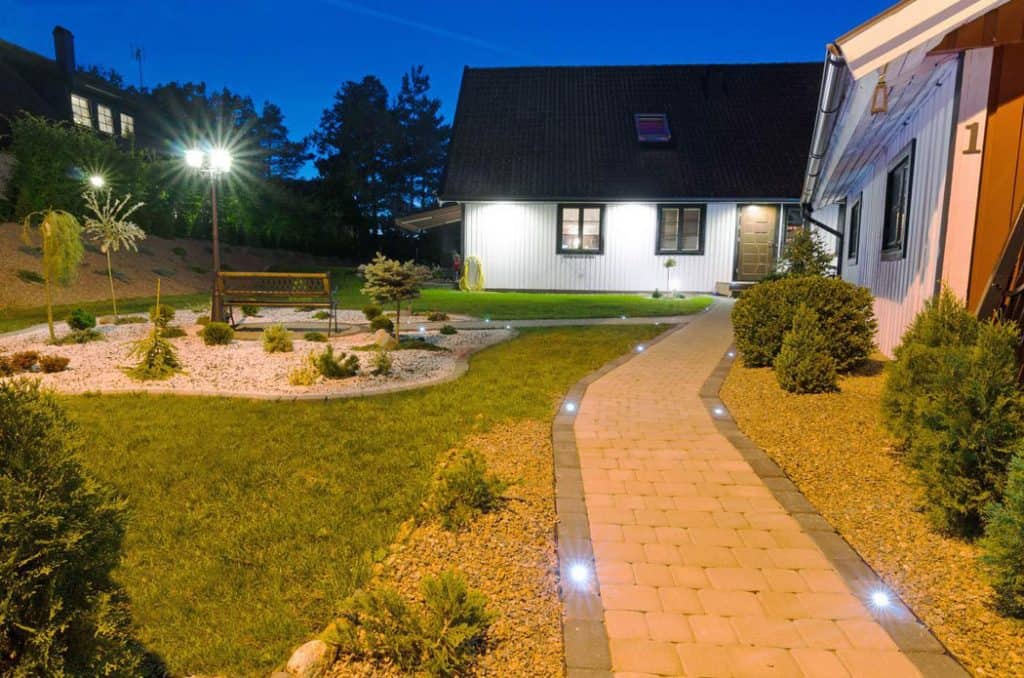
Installation varies by fixture and hardscape system, but a professional process generally includes the following steps.
1. Define the lighting purpose
The designer identifies which areas need guidance, accent, step, wall, task, or general illumination.
2. Select compatible fixtures
Each fixture is selected based on:
- Paving material
- Traffic
- Moisture exposure
- Light output
- Beam direction
- Color temperature
- Service access
- Transformer compatibility
3. Create the electrical and control plan
The installer calculates the fixture load, cable runs, transformer capacity, voltage requirements, controls, and future expansion.
4. Coordinate with the hardscape
Fixture sleeves, mounting components, wire routes, paver cuts, drainage, base support, and joint details are planned before permanent installation.
5. Install approved cable and connections
Outdoor-rated cable and waterproof or manufacturer-approved connectors are installed according to the selected system.
Integral Lighting, for example, recommends waterproof connectors containing silicone or dielectric material and emphasizes following the connector manufacturer’s instructions.
6. Install and align the fixtures
Fixtures are secured according to their instructions and positioned so they do not create a raised edge, unstable paver, or service problem.
7. Test voltage and operation
The installer tests the system, controls, fixture output, and voltage before the surface is fully restored.
8. Restore the paving
Pavers, stone, bedding, joints, and surrounding surfaces are restored using materials compatible with the original installation and selected fixture.
9. Evaluate the system after dark
The final aiming, output, timing, and zoning should be reviewed at night, when glare and dark areas can be accurately assessed.
Do not use one generic combination of landscape fabric, loose sand, wire, and fixtures for every paver-light system. The complete method must follow the fixture manufacturer, paving system, and site conditions.
Do Paver Lights Improve Security?
Paver lights can increase visibility around a walkway, patio, driveway, or entrance, but they should not be described as a complete security system.
Security planning may require:
- Broader area lighting
- Entry lighting
- Motion detection
- Cameras
- Door and window security
- Clear lines of sight
- Coordination with a qualified security professional
Use paver lighting primarily for wayfinding, accent lighting, and visual definition.
Do Paver Lights Need a Permit or Electrician?
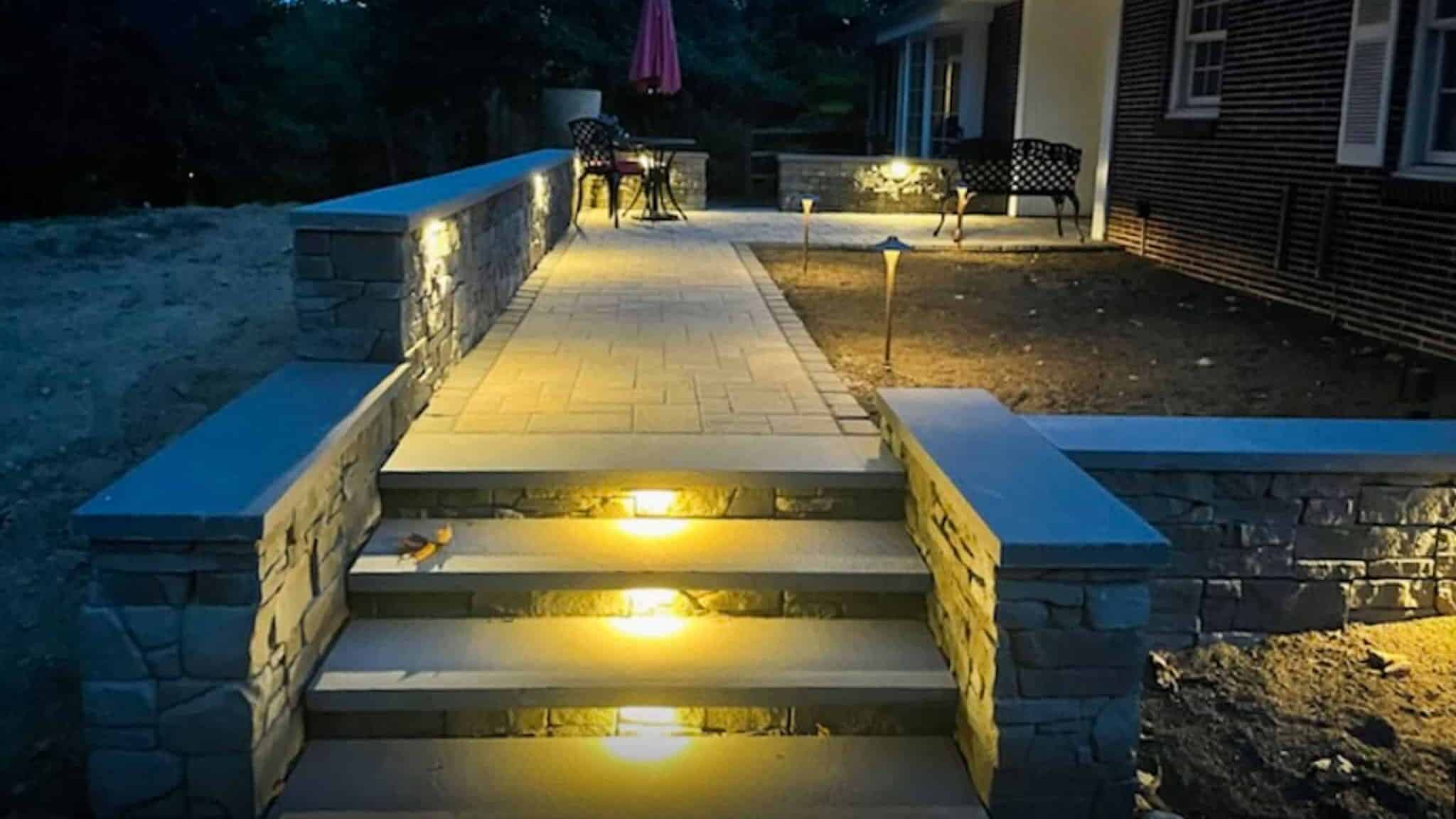
Requirements depend on the municipality, electrical work, transformer installation, power source, and project scope.
A plug-in low-voltage system may be treated differently from work involving:
- A new outdoor receptacle
- Line-voltage wiring
- A hardwired transformer
- A new circuit
- Pool or spa areas
- Building penetrations
- Outdoor kitchens
- Retaining walls or structures
- Commercial property
Work on line-voltage circuits and permanent electrical infrastructure should be performed by a properly qualified professional.
Homeowners should confirm local requirements before construction. Kelly Masonry should also clearly state whether electrical work is performed directly or coordinated with a licensed electrical contractor.
How Do You Maintain Paver Lights?
Keep the lens visible
Remove leaves, soil, mulch, snow, and organic buildup that blocks the fixture.
Use compatible cleaning methods
Follow the fixture manufacturer’s instructions. Abrasive tools and harsh chemicals can damage lenses, finishes, seals, or surrounding masonry.
Inspect the paving
Watch for settlement, loose pavers, open joints, or movement around the fixture. A light should not be used to hold an unstable paver in place.
Monitor water accumulation
Standing water may indicate a drainage or grading problem even when a fixture has a high water-resistance rating.
Test the system
Check for:
- Flickering
- Dim fixtures
- Color inconsistency
- Failed zones
- Timer or photocell problems
- Exposed or damaged cables
- Corroded or loose connections
Preserve service access
Do not permanently cover replaceable components, junctions, or service points with mortar, concrete, or landscaping unless the system is specifically designed for that installation.
Watch Kelly Masonry’s landscape-lighting maintenance video for additional maintenance guidance.
Why Do Paver Lights Fail?
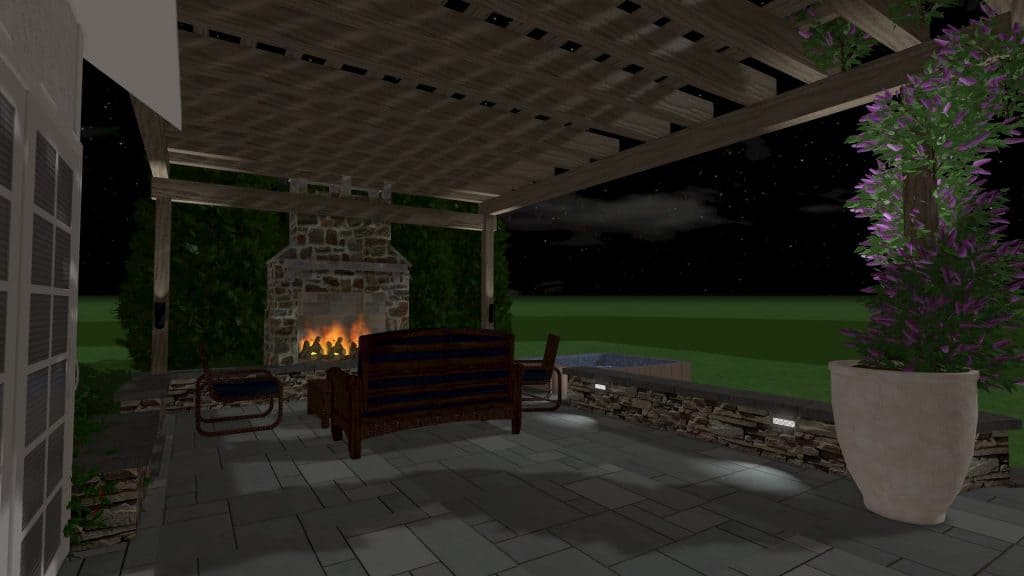
Common causes may include:
- Water entering an unsuitable fixture or connection
- Damaged cable
- Incompatible connectors
- An overloaded or unsuitable transformer
- Voltage loss
- Failed LEDs or internal drivers
- Paver movement
- Vehicle loads exceeding the fixture rating
- Debris covering the lens
- Corrosion
- Landscape work damaging the wiring
- Inaccessible installation
- Using an indoor-rated component outdoors
A failed fixture should be diagnosed before it is replaced. Installing another identical light without correcting the cause may result in another failure.
Frequently Asked Questions
Are paver lights safe to walk on?
Only when the fixture is specifically rated and installed for pedestrian traffic. The fixture must also remain flush and stable within the surrounding paving.
Can you drive over paver lights?
Only use fixtures with a manufacturer-confirmed drive-over or load rating appropriate for the expected vehicle traffic.
Are paver lights waterproof?
Water resistance varies by product. Review the exact wet-location, submersion, or IP rating and install the fixture according to the manufacturer’s requirements.
Do paver lights need a transformer?
Low-voltage paver lights require a compatible transformer or power supply. Solar paver lights use individual solar panels and rechargeable batteries.
How many paver lights do I need?
The number depends on the layout, fixture output, spacing, purpose, nearby lighting, and desired visual effect. A scaled lighting plan is more reliable than one universal fixture count.
How far apart should paver lights be?
Spacing varies by fixture and application. Follow product-specific guidance and test representative fixture positions after dark.
Can paver lights be installed in a driveway?
Yes, when the fixtures and installation are specifically rated for the expected vehicle loads and environmental exposure.
Can paver lights be installed around a pool?
Possibly, but pool and spa areas have additional electrical and equipment requirements. Use products specifically approved for the location and coordinate the design with qualified professionals and local authorities.
Can paver lights be added to existing pavers?
Often, but the installer must plan paver removal, cable routing, fixture support, drainage, joint restoration, and future service access.
Do paver lights cause drainage problems?
They should not when properly integrated into the hardscape. However, unsuitable fixture placement, base disruption, or poor surface grading can contribute to water accumulation.
Do paver lights need maintenance?
Yes. Keep lenses clean, inspect the surrounding paving, test the system, monitor water accumulation, and address flickering, dimming, or damaged components promptly.
How long do paver lights last?
There is no single lifespan. Performance depends on fixture quality, LED and driver design, moisture protection, electrical connections, voltage, paving stability, traffic, climate, and maintenance.
Are solar paver lights as bright as wired lights?
Performance varies by product. Solar output depends on panel exposure, battery condition, season, weather, and fixture design. Wired low-voltage systems generally provide more consistent output when properly designed.
Can paver lights be dimmed?
Some systems support dimming, but compatibility depends on the fixture, transformer, controller, and manufacturer requirements.
About the Author
John Kelly is the founder of Kelly Masonry and has more than 25 years of masonry, hardscape, and outdoor-living experience. His team designs and installs patios, walkways, walls, landscape lighting, and complete outdoor spaces throughout Delaware County, the Main Line, and surrounding Pennsylvania communities.
Reviewed by: John Kelly
Last updated: July 30, 2026
Planning Paver or Landscape Lighting?
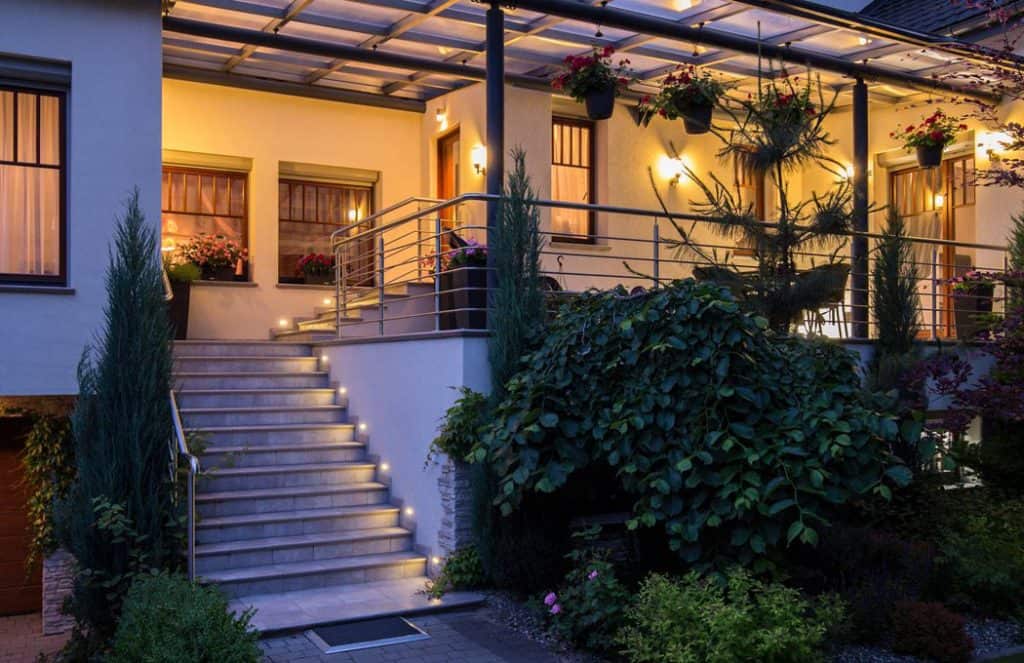
Kelly Masonry can evaluate your patio, walkway, driveway, steps, walls, landscape, electrical access, and project goals before developing a coordinated lighting plan.
Explore our landscape-lighting services, review our project process, browse our outdoor-living portfolio, or request a consultation.