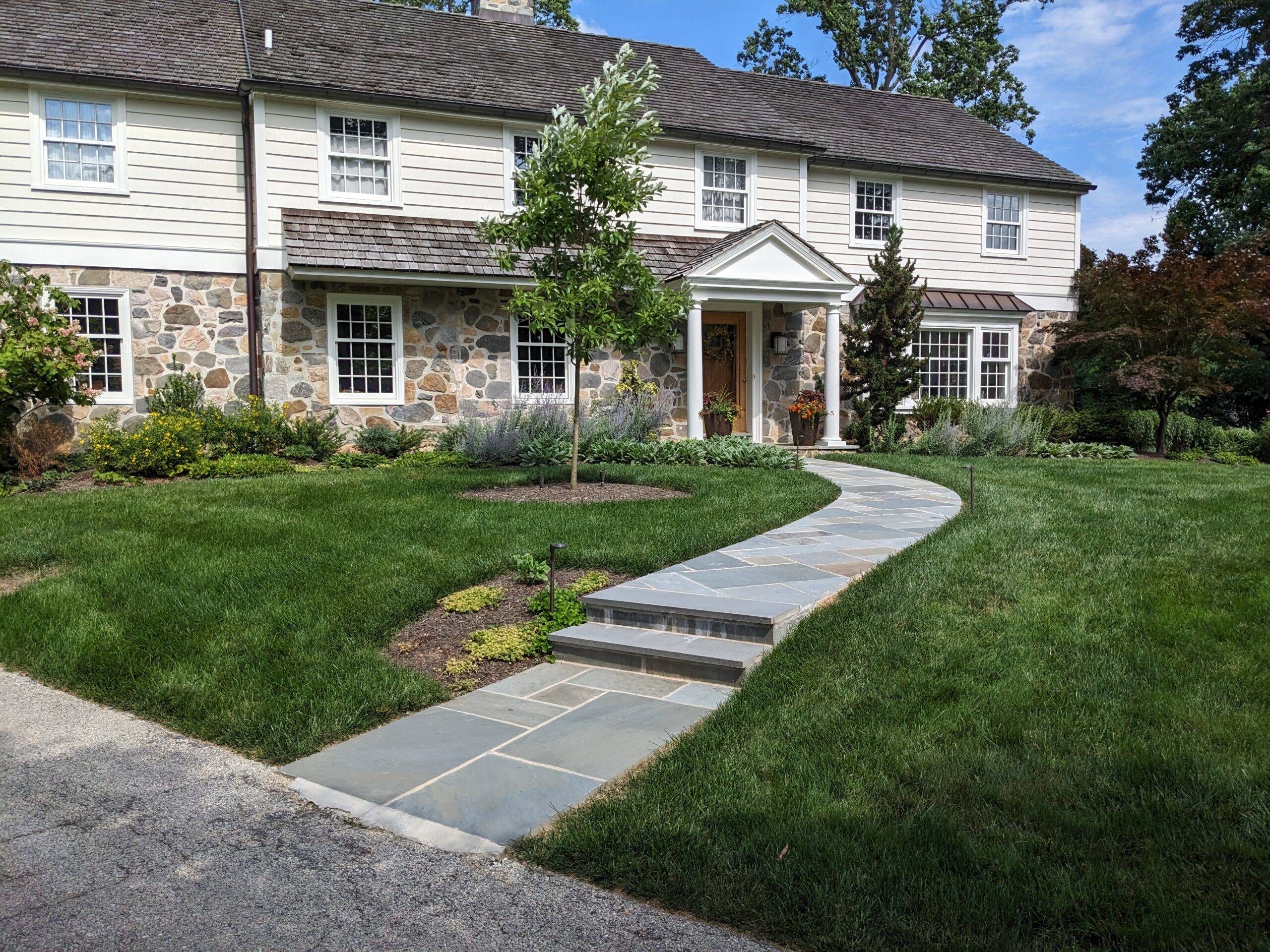
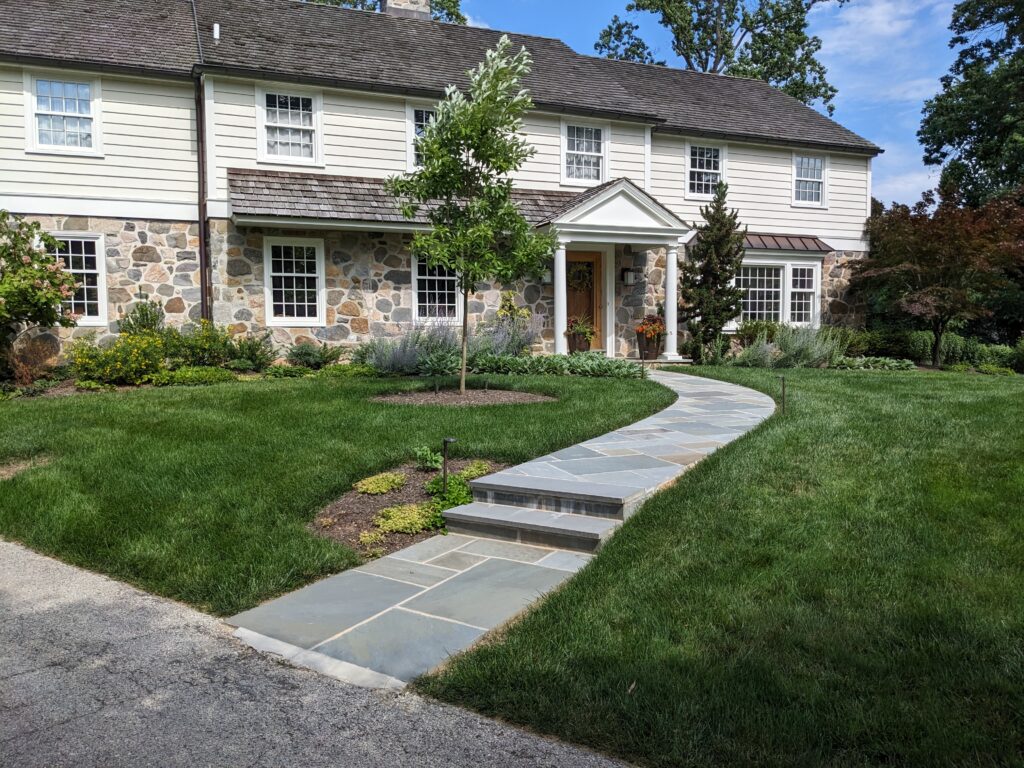
A durable flagstone walkway requires more than attractive stone.
The walkway must use:
- Natural stone suitable for exterior paving
- A route and width appropriate for its intended use
- A stable, well-drained foundation
- An installation system selected before construction
- Consistent walking surfaces
- Joints compatible with the stone and base
- Correct grading and transitions
The three main installation options are dry-laid flagstone, mortar-set flagstone, and individual stepping stones. These systems use different foundations and joint treatments and should not be combined without a complete design.
Kelly Masonry designs, builds, and repairs natural-stone walkways throughout Delaware County and the Main Line.
Flagstone Walkways at a Glance
| Question | Direct answer |
|---|---|
| What is flagstone? | A general term for flat pieces of natural stone used for paving and landscaping |
| What stone is commonly used in Pennsylvania? | Pennsylvania bluestone is common, but sandstone, limestone, slate, quartzite, and other stones may also be sold as flagstone |
| Is dry-laid or mortar-set better? | Dry-laid construction offers easier individual-stone adjustment, while mortar-set construction can create narrower, more rigid joints when supported by a suitable slab |
| Does flagstone need a concrete base? | Not always. Dry-laid walkways commonly use compacted aggregate, while mortar-set work may use a reinforced concrete foundation designed for the assembly |
| Can polymeric sand be used? | Sometimes, but only when the product is approved for the joint width, depth, stone, and installation system |
| Is flagstone accessible? | It can provide a usable walking surface when stones are large, stable, relatively even, and installed with controlled joints and transitions |
| Does flagstone need to be sealed? | Not automatically. The decision depends on the exact stone, finish, exposure, stain risk, and treatment compatibility |
| How much does a flagstone walkway cost? | Kelly Masonry currently publishes walkway planning levels around $10,000, $20,000, and $30,000 or more, depending on scope |
| Can loose stones be repaired? | Often, but the failed base, bedding, drainage, or setting material should be corrected rather than only refilling the joints |
What Is a Flagstone Walkway?
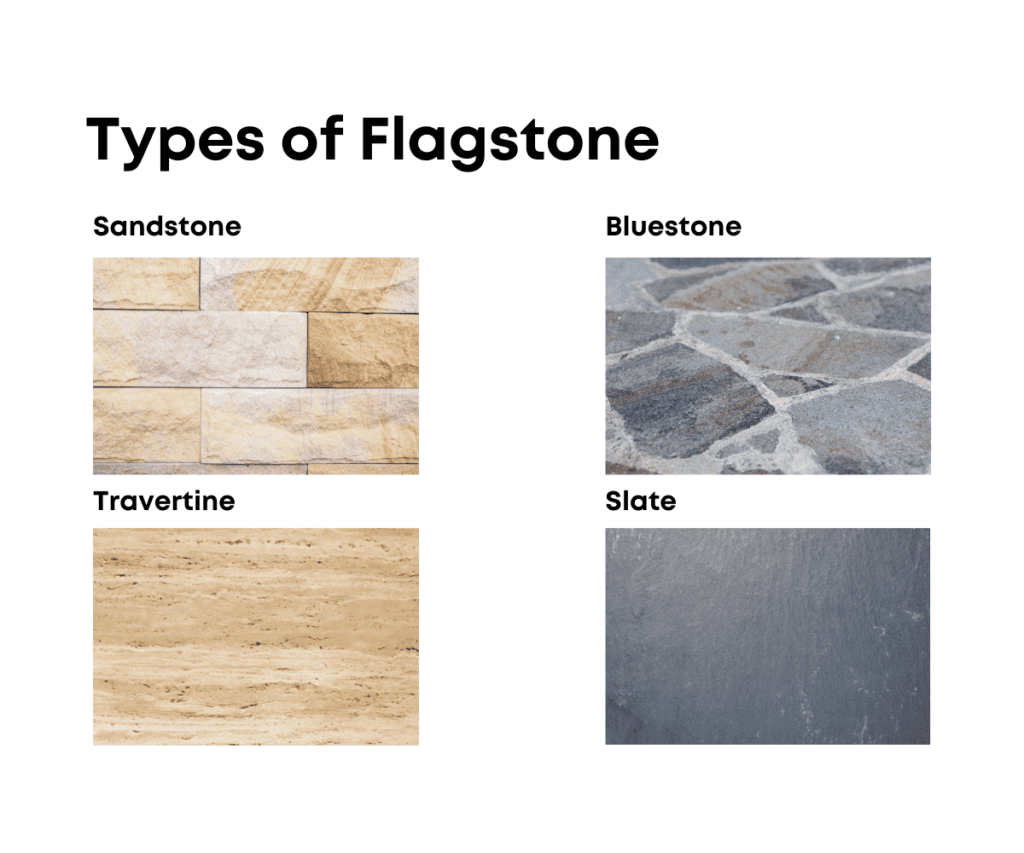
Flagstone is not one specific geological stone.
It is a broad paving term for relatively flat pieces of natural stone. Products sold as flagstone may include:
- Pennsylvania bluestone
- Sandstone
- Limestone
- Slate
- Quartzite
- Granite
- Other regionally available stones
Each product has different:
- Strength
- Water absorption
- Freeze-thaw performance
- Surface texture
- Thickness
- Color variation
- Cleaving characteristics
- Exterior-paving suitability
Do not choose flagstone from color alone. Ask the supplier for the exact stone name, quarry or source when available, intended exterior application, thickness, finish, and relevant performance information.
Read our broader guide to flagstone types, costs, installation, and maintenance.
Choose the Walkway Type Before Designing the Base
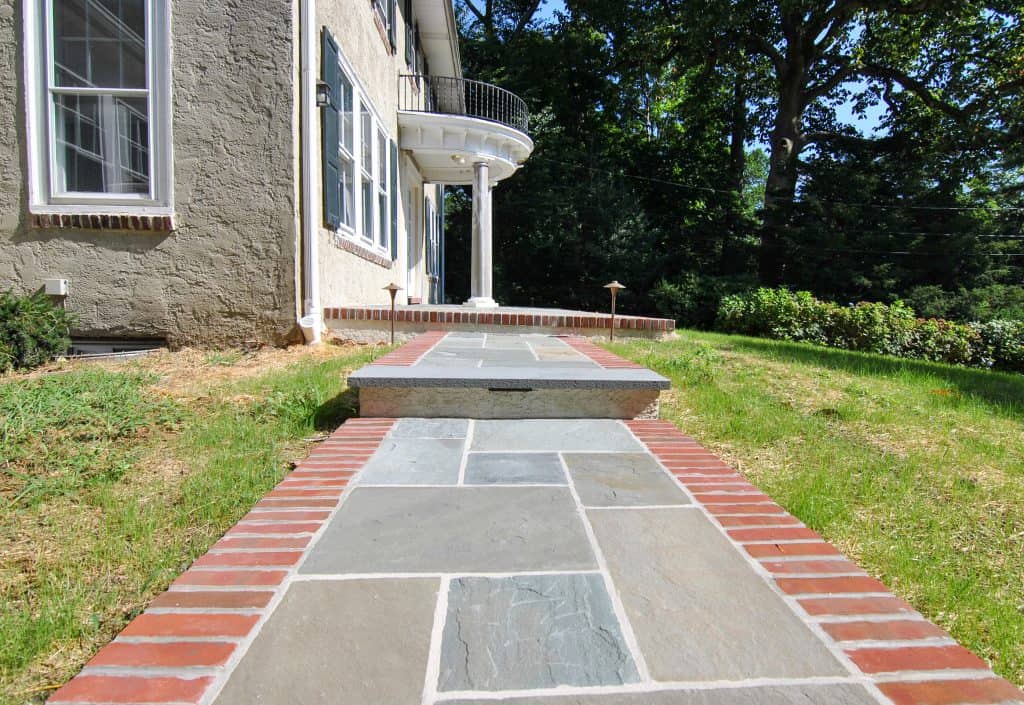
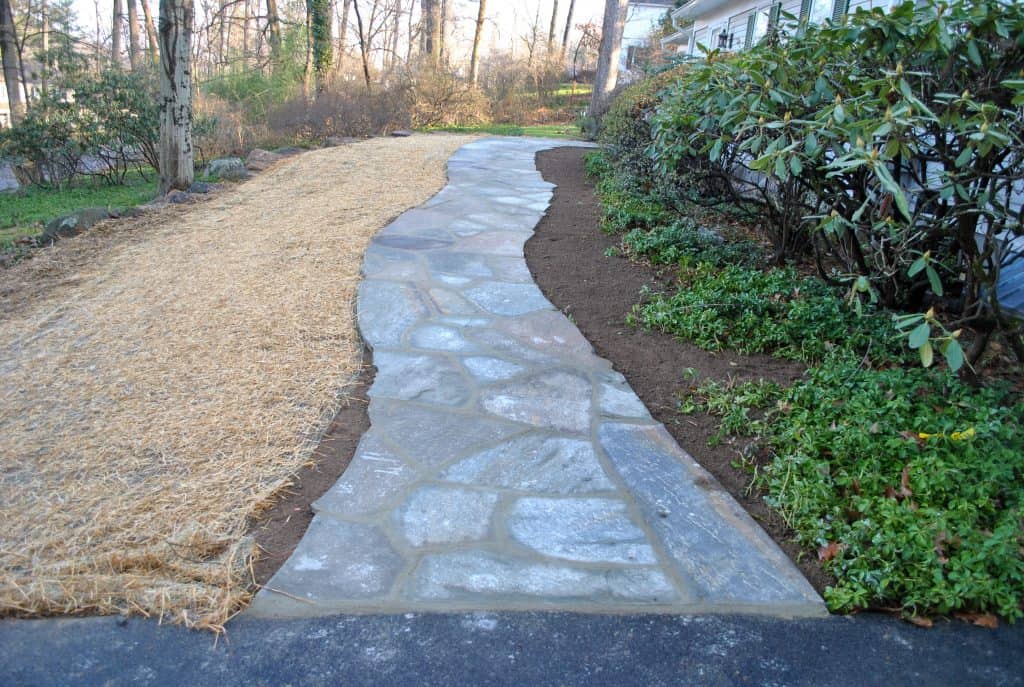
Dry-laid flagstone walkway
A dry-laid walkway generally places the stones over a compacted aggregate foundation and suitable bedding layer.
The joints may contain:
- Stone screenings
- Sand
- Fine aggregate
- A compatible polymeric jointing product
- Selected planted material in informal applications
Advantages may include:
- Individual stones can often be lifted and reset
- The surface can accommodate limited movement
- Repairs may be localized
- The appearance can be informal or highly finished
Important considerations include:
- Base stability
- Stone thickness
- Edge support
- Joint width
- Settlement
- Joint-material migration
- Weed and debris maintenance
Mortar-set flagstone walkway
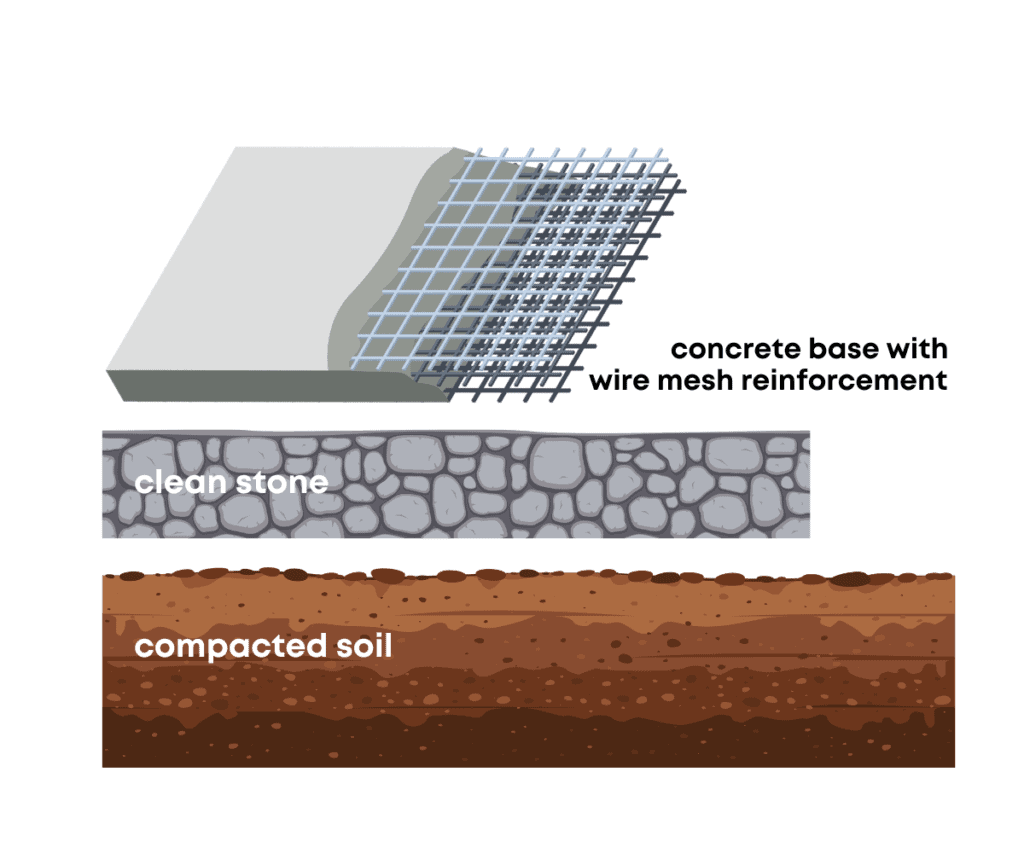
A mortar-set walkway installs the stone as part of a rigid assembly, commonly over a properly designed concrete foundation.
The assembly may include:
- Prepared supporting soil
- Aggregate
- Concrete slab
- Reinforcement where specified
- Drainage and movement details
- Mortar or another approved setting material
- Mortared joints
Advantages may include:
- Narrower and more consistent joints
- A more formal finished appearance
- A firm surface when correctly installed
- Better control of uneven stone thickness through the setting bed
Important considerations include:
- Cracking
- Movement
- Drainage
- Freeze-thaw exposure
- Slab design
- Stone and mortar compatibility
- Repair visibility
- Curing and weather protection
Mortar-set flagstone should not be installed by pouring general concrete mix and immediately tapping stones into it without a complete assembly design.
Stepping-stone path
A stepping-stone walkway uses separate stones rather than creating one continuous paved surface.
It may suit:
- Garden paths
- Secondary routes
- Informal landscapes
- Low-traffic areas
- Routes where a full-width walkway is unnecessary
A stepping-stone path is generally less appropriate for:
- Main entrances
- Wheeled mobility
- Strollers
- Frequent package carrying
- Mechanical snow clearing
- High pedestrian traffic
Plan the Route and Width
The path should follow the route people naturally want to use.
Consider:
- Driveway and sidewalk connections
- Front and side doors
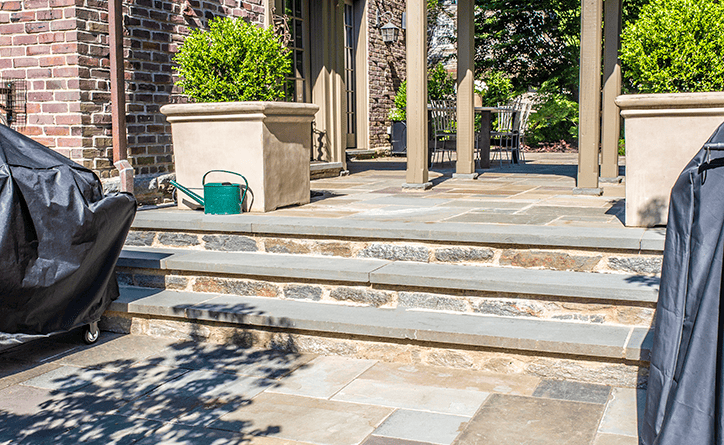
- Steps and landings
- Gardens and existing trees
- Utilities
- Slopes
- Downspouts
- Drainage
- Snow removal
- Furniture or equipment movement
- Future landscaping
Walkway width
A primary front walkway is often more comfortable at approximately four to five feet wide.
A three-foot route may work for:
- Secondary walkways
- Garden paths
- Space-constrained locations
- Routes normally used by one person at a time
Read our detailed guide to choosing the right front-walkway width.
Straight or curved?
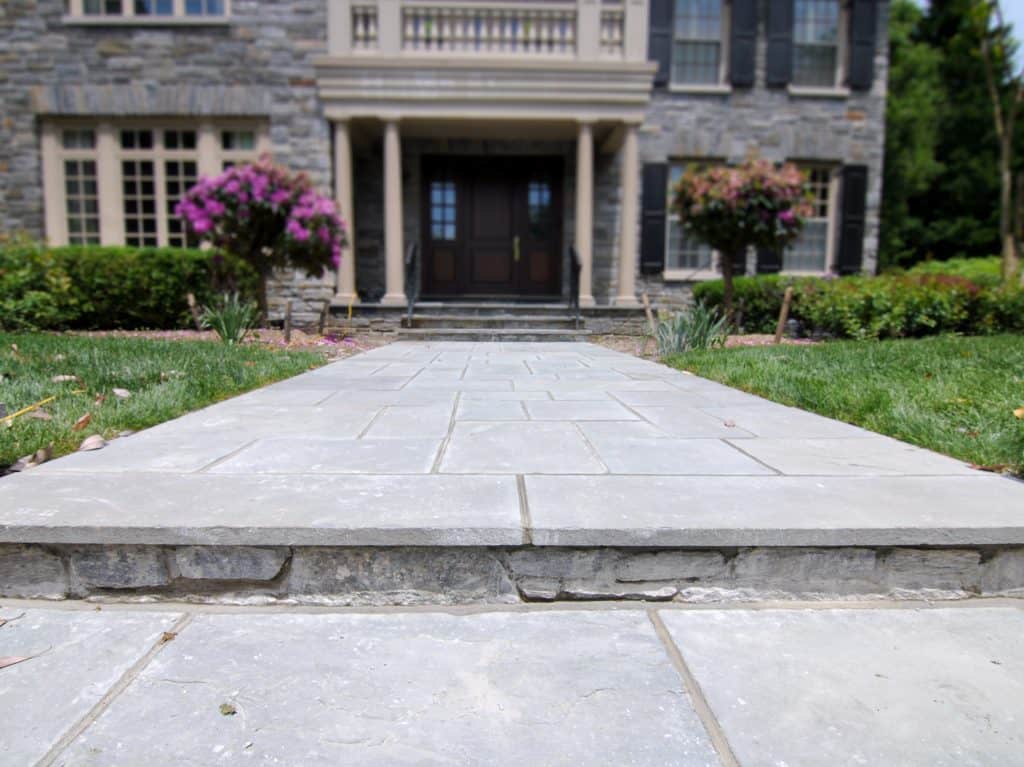
A straight route may suit:
- Formal architecture
- Short connections
- Symmetrical entrances
- Direct driveway-to-door access
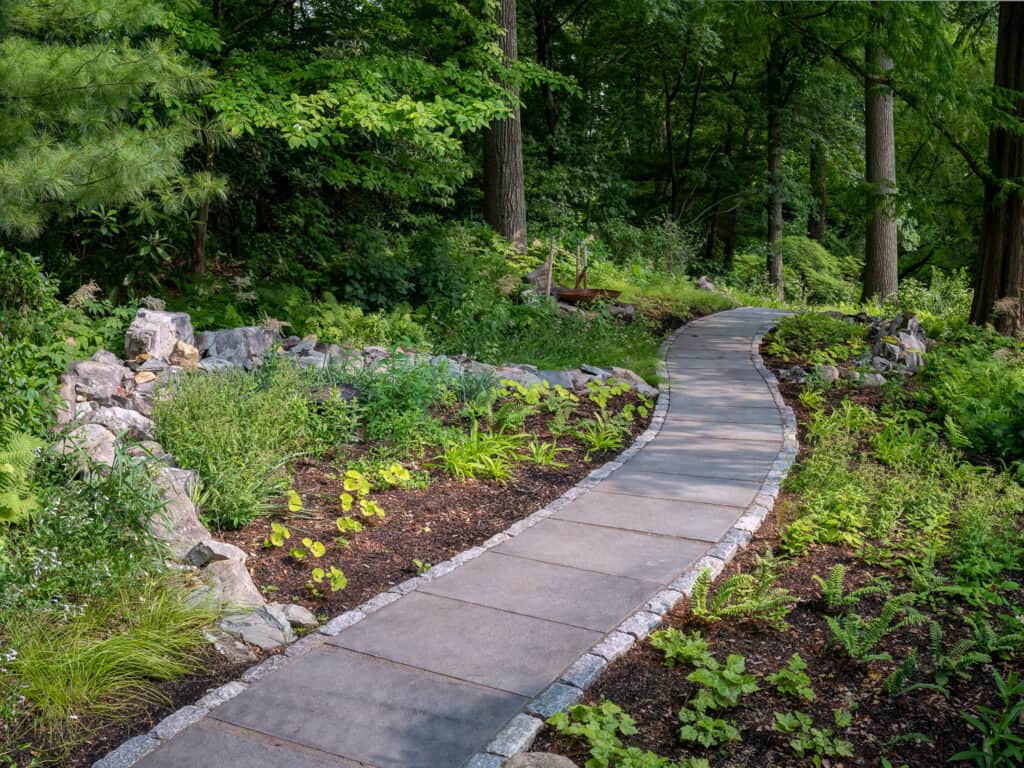
A curved route may suit:
- Naturalistic landscaping
- Existing trees
- Sloped properties
- Longer paths
- Intentional focal points
Curves should respond to the property rather than being added only for decoration.
Plan for Accessibility and Everyday Use
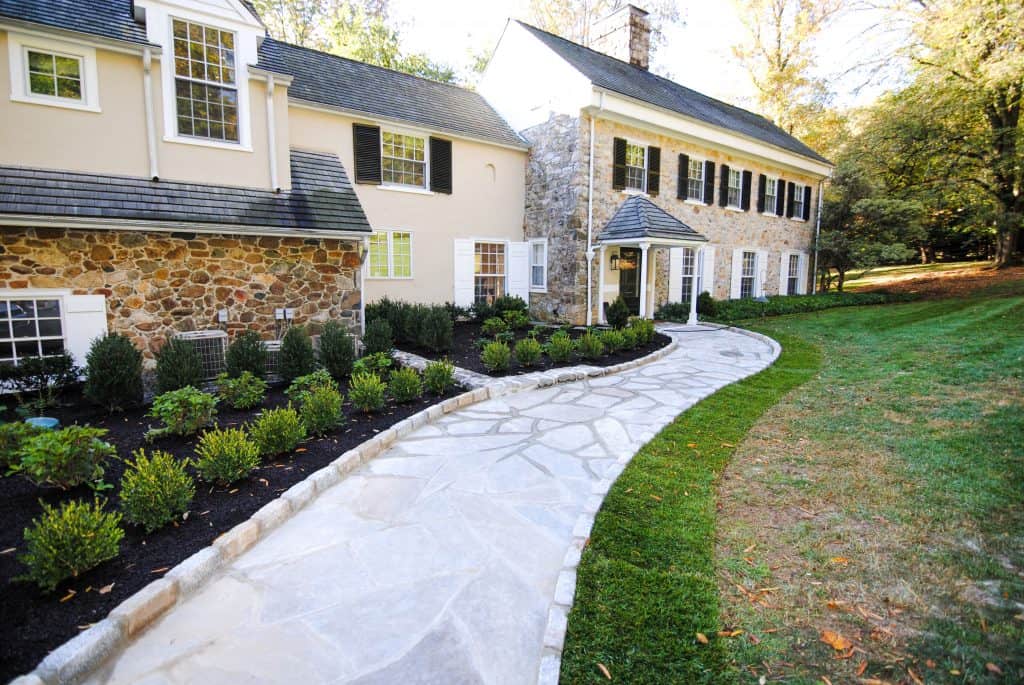
A successful walking surface should be:
- Stable
- Firm
- Appropriately slip resistant
- Free from rocking stones
- Relatively consistent in elevation
- Designed with controlled joints
- Coordinated with steps and doors
For easier movement:
- Use larger stones where possible
- Minimize abrupt level changes
- Keep joints consistent
- Avoid unstable loose fill
- Provide sufficient clear width
- Control surface water
- Select an appropriate stone finish
- Allow turning and door-operating space where needed
The federal accessibility standards do not automatically govern every private residential walkway, but their principles provide useful planning references.
The U.S. Access Board explains that accessible walking surfaces should be firm, stable, and slip resistant.
Select Stone for Pennsylvania Conditions
Pennsylvania walkways experience:
- Repeated rain
- Snow and ice
- Freeze-thaw cycling
- Summer heat
- Organic staining
- Deicing materials
- Seasonal soil moisture
Before selecting stone, evaluate:
- Documented exterior use
- Water absorption
- Freeze-thaw history
- Surface finish
- Wet traction
- Thickness
- Size
- Edge condition
- Natural variation
- Availability for future repairs
The Natural Stone Institute maintains technical resources covering natural-stone paving, freeze-thaw exposure, sealers, joints, and stone selection.
Some limestone, sandstone, slate, and other stone varieties perform successfully outdoors, while others may not be suitable for horizontal paving in a freeze-thaw climate. Evaluate the specific product rather than relying on the general stone name.
Plan the Walkway Foundation
There is no universal excavation depth or base specification for every flagstone walkway.
The design depends on:
- Dry-laid or mortar-set construction
- Stone thickness
- Supporting soil
- Existing fill
- Drainage
- Slope
- Expected traffic
- Tree roots
- Freeze-thaw exposure
- Connections with steps and structures
A typical professional process includes:
1. Site evaluation
The contractor inspects:
- Existing grades
- Soil
- Drainage
- Downspouts
- Utilities
- Roots
- Foundations
- Steps
- Property access
- Existing pavement
Contact Pennsylvania One Call before excavation so underground utilities can be identified.
2. Layout and elevation planning
The route, width, finished elevation, pitch, steps, and drainage outlet are established before excavation.
3. Excavation
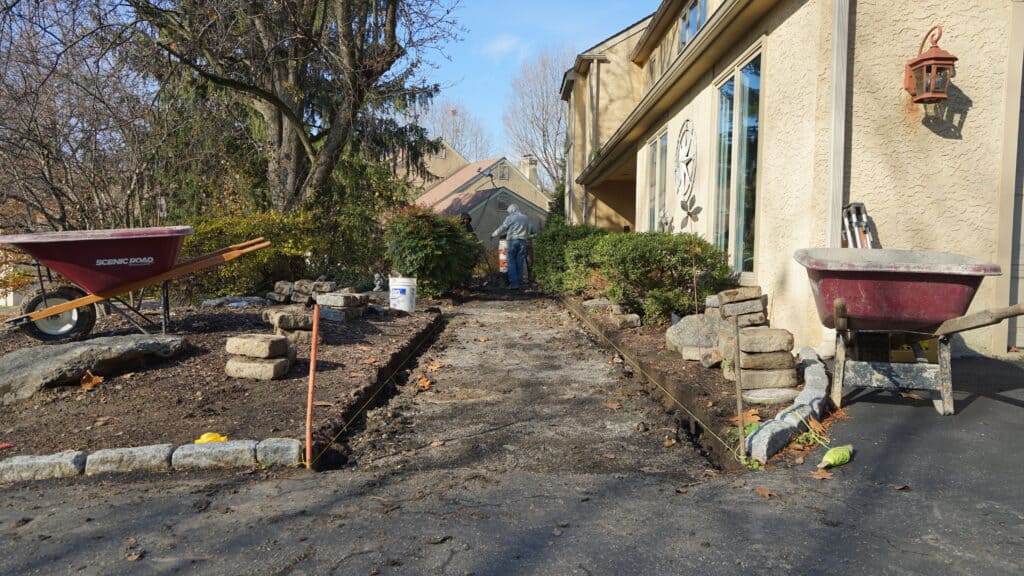
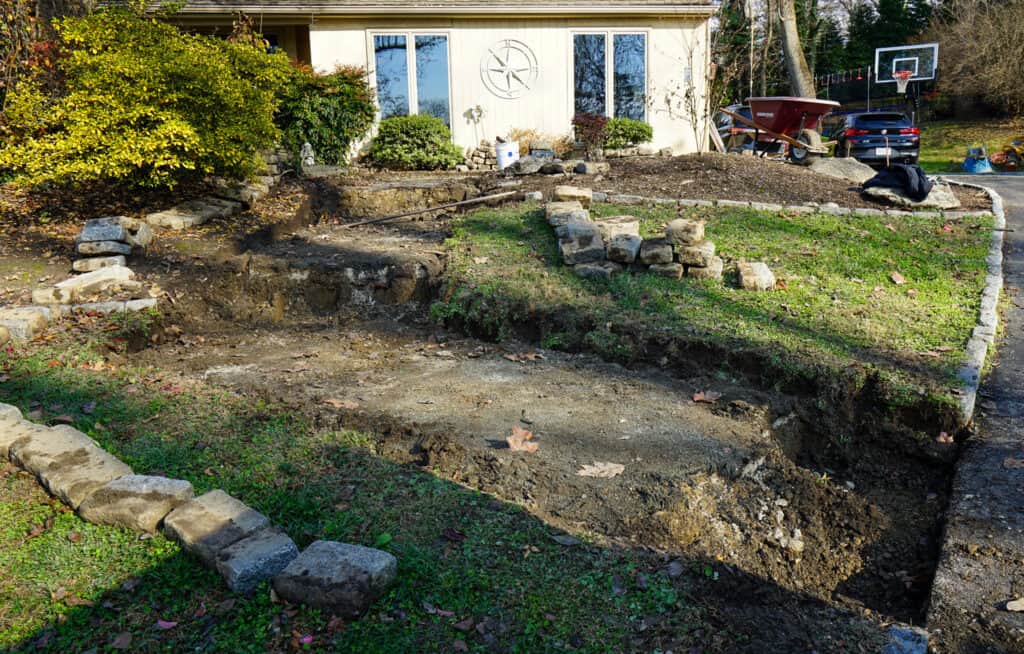
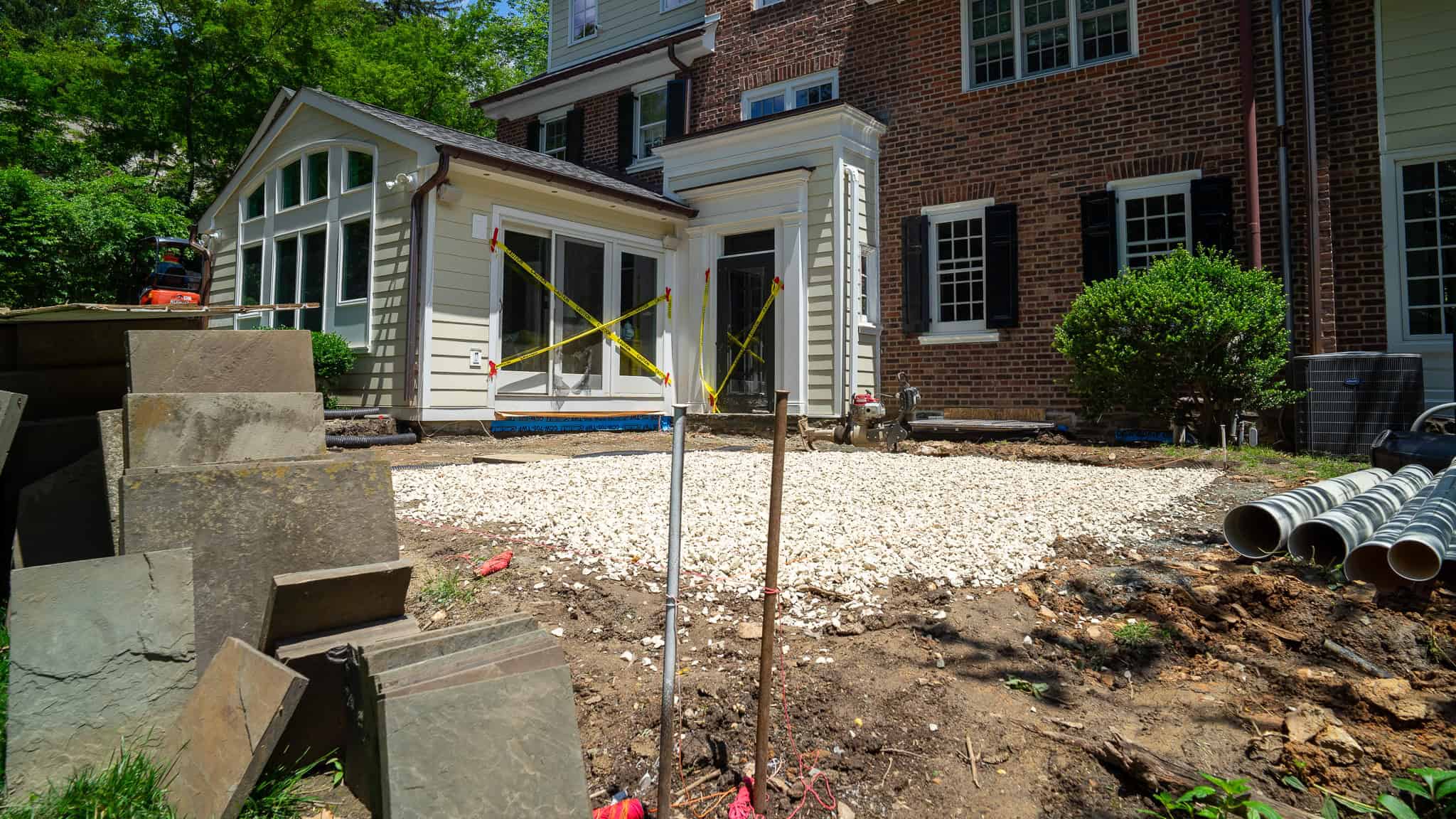
Unsuitable soil, vegetation, organic material, and failed pavement are removed to the depth required by the chosen system.
4. Subgrade preparation
The exposed soil is evaluated and prepared. Weak or wet areas may require correction rather than simply being covered.
5. Base installation
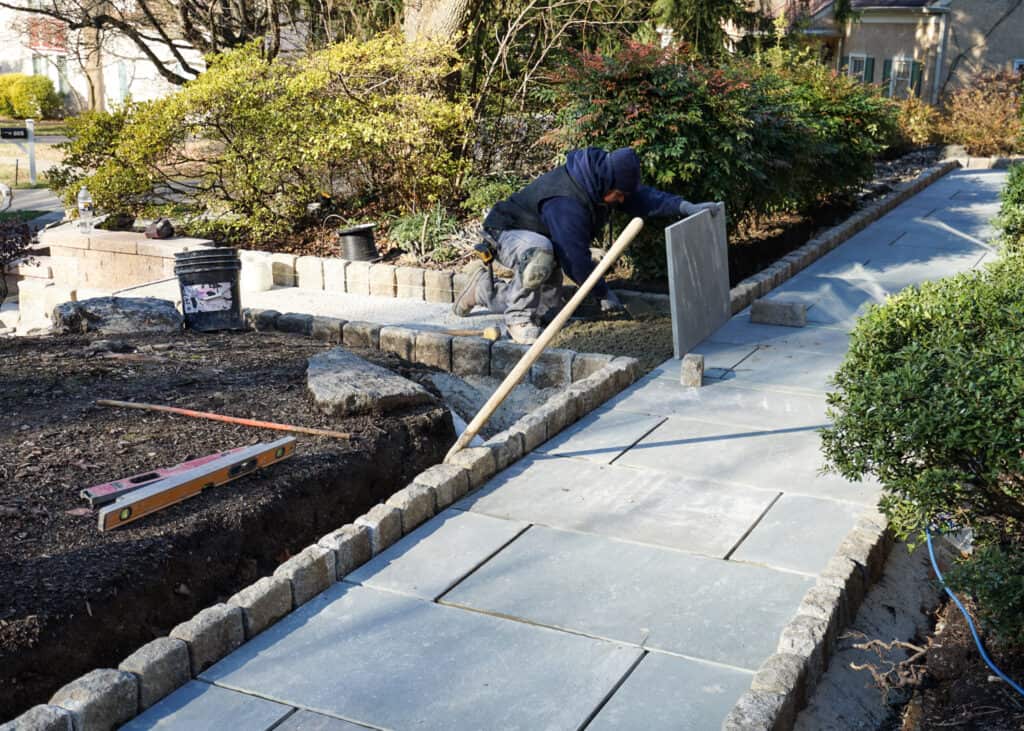
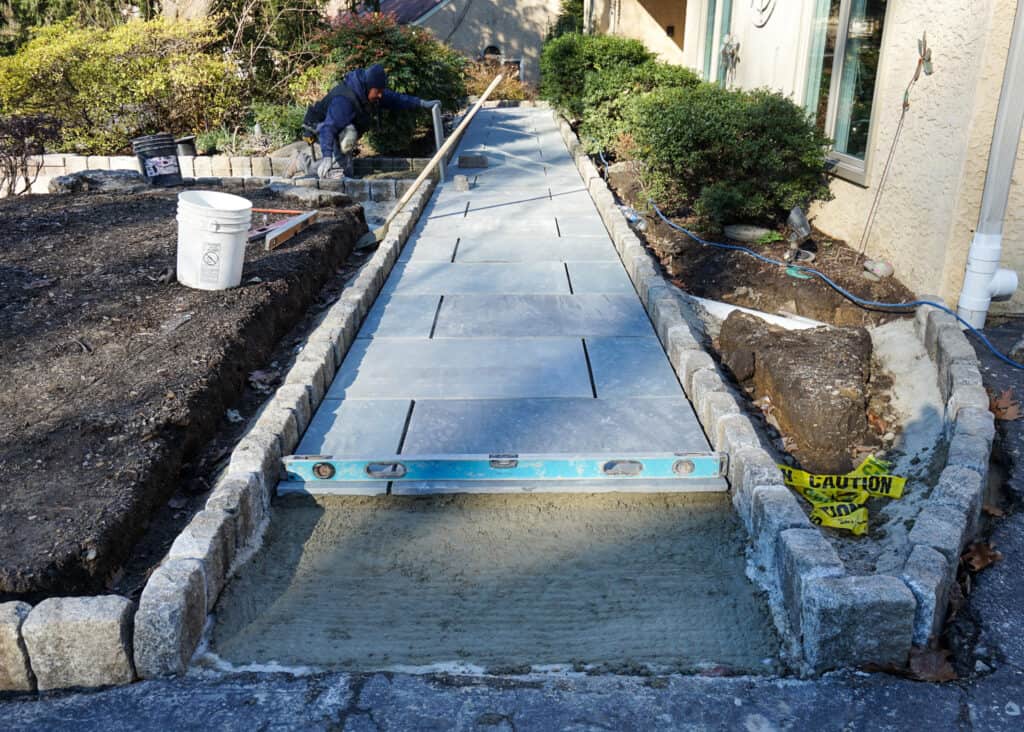
Aggregate or a rigid foundation is installed according to the chosen construction method.
A dry-laid system and a mortar-set system should not share one generic base instruction.
6. Bedding or setting material
Dry-laid stones receive a suitable bedding layer.
Mortar-set stones require a setting system compatible with the concrete foundation and natural stone.
7. Stone layout and fitting
Stones are selected and arranged to provide:
- Stable bearing
- Natural visual balance
- Controlled joints
- Comfortable walking areas
- Logical edge conditions
- Suitable transitions
8. Joint installation
The joint material is selected for the exact system.
9. Edge and transition completion
The walkway is coordinated with:
- Lawn
- Planting beds
- Driveways
- Steps
- Patios
- Doors
- Public sidewalks
10. Curing and protection
Mortar, concrete, polymeric products, and sealers—when used—require product-specific weather and curing conditions.
How Should Flagstone Joints Be Filled?
The correct joint material depends on the installation.
Loose or compacted aggregate joints
These may suit selected dry-laid walkways.
They may require periodic replenishment and cleaning.
Polymeric jointing products
A polymeric product may be appropriate when:
- The manufacturer approves natural stone
- Joint width and depth fall within the product limits
- The base drains as required
- The stone surface can be cleaned safely
- Installation and curing conditions are suitable
Polymeric joint material is not automatically waterproof or weedproof.
Weeds frequently grow when windblown seeds germinate in organic material collected above the joint. Read why weeds grow in polymeric-sand joints.
Mortared joints
Mortar is used in compatible rigid installations.
Mortared joints require consideration of:
- Joint dimensions
- Mortar compatibility
- Movement
- Curing
- Moisture
- Freeze-thaw exposure
- Repairability
Do not install mortar over a flexible walkway merely to create a rigid-looking joint. Movement beneath the stones can cause the mortar to crack and separate.
Planted joints
Groundcover may suit an informal garden path when:
- The location receives suitable light
- Irrigation does not damage the walkway or foundation
- Plants do not create a slippery surface
- Regular maintenance is acceptable
- Accessibility is not the main objective
How Far Apart Should Stepping Stones Be?
There is no universal spacing that works for every person.
Place several stones temporarily and walk the path in both directions. Test the route with the people who will use it most often.
Consider:
- Natural stride
- Stone size
- User age
- Carrying items
- Slope
- Direction changes
- Snow
- Wet conditions
The goal is for each user to step naturally onto a stable portion of the next stone without stretching or shortening every stride.
How Should a Flagstone Walkway Drain?
The surface should direct water toward an appropriate outlet rather than:
- Toward the foundation
- Into doorways
- Across steps
- Into low areas
- Onto neighboring properties
- Beneath unstable edges
Drainage planning may include:
- Surface pitch
- Changes to adjacent grades
- Downspout extensions
- Underground drainage
- Area or channel drains
- Permeable joint systems
- Swales
- Edge adjustments
A dry-laid walkway is not automatically a stormwater solution. Compacted soil, fine joints, and the base may still limit infiltration.
Read our guide to yard and hardscape drainage solutions.
Does a Flagstone Walkway Need a Permit?
A straightforward private walkway may not require the same permit review as structural work, but requirements vary.
Municipal review may become relevant when the project includes:
- Public sidewalks
- Work within a right of way
- Significant grading
- Drainage systems
- Steps
- Handrails
- Retaining walls
- Electrical lighting
- Historic-district requirements
- Changes near property lines
Pennsylvania uses the Uniform Construction Code, while most municipalities administer local permits and zoning.
Confirm requirements with the township or borough before beginning work.
How Much Does a Flagstone Walkway Cost?
Kelly Masonry currently publishes the following walkway planning levels:
| Walkway level | Current planning range |
|---|---|
| Basic walkway | Approximately $10,000 |
| Average walkway | Approximately $20,000 |
| High-end walkway | $30,000 or more |
These ranges may include brick, flagstone, or paver walkways and are not flagstone-only prices.
Cost depends on:
- Walkway length and width
- Stone type
- Dimensional or irregular layout
- Dry-laid or mortar-set construction
- Demolition
- Excavation
- Soil
- Access
- Base
- Drainage
- Stone cutting
- Joint material
- Steps
- Borders
- Lighting
- Landscaping
- Permit requirements
Review Kelly Masonry’s current walkway pricing or use the project pricing calculator.
How Do You Maintain a Flagstone Walkway?
Routine care may include:
- Sweeping away leaves and organic debris
- Removing weeds before roots become established
- Checking for rocking or settled stones
- Inspecting loose or missing joint material
- Monitoring drainage
- Cleaning stains with a stone-compatible method
- Avoiding aggressive pressure washing
- Using winter products appropriate for the exact stone
- Repairing damaged mortar where applicable
Does flagstone need sealer?
Not automatically.
A sealer may alter:
- Color
- Gloss
- Traction
- Moisture movement
- Maintenance requirements
Before applying one:
- Identify the exact stone.
- Determine what problem the treatment is meant to solve.
- Confirm compatibility with the stone and joint material.
- Complete a test area.
- Allow it to dry fully before evaluating the result.
Do not apply a generic concrete sealer to natural stone without confirming that it is approved for that stone and application.
Why Do Flagstone Walkways Become Uneven?
Possible causes include:
- Inadequate base preparation
- Weak or wet soil
- Poor drainage
- Tree roots
- Edge movement
- Freeze-thaw cycling
- Loss of bedding material
- Settlement near utilities or foundations
- Failed mortar or concrete
- Heavy construction traffic
Adding joint sand around a rocking stone usually does not correct the underlying support problem.
The stone should be lifted or removed as appropriate, the foundation diagnosed, and the affected system repaired.
Explore Kelly Masonry’s patio and walkway repair services.
Can You Build a Flagstone Walkway Yourself?
A small garden stepping-stone path may be manageable for some homeowners.
Professional design and installation are more important when the walkway:
- Leads to the main entrance
- Includes steps
- Has significant slope
- Must manage roof or yard drainage
- Connects with masonry structures
- Requires mortar-set construction
- Must support accessibility goals
- Crosses utilities
- Requires extensive excavation
- Uses heavy or irregular stone
A professional contractor should be able to explain:
- Why the stone was selected
- Which installation system will be used
- How the base was designed
- Where water will drain
- Which joint material is compatible
- How steps and transitions will be completed
- What maintenance will be required
Read about Kelly Masonry’s design and construction process.
Frequently Asked Questions
What is the best stone for a flagstone walkway?
There is no universal best stone. Pennsylvania bluestone is common, but the best choice depends on exterior performance, finish, thickness, architecture, availability, maintenance, and budget.
How far apart should stepping stones be?
Stepping stones should be tested according to the users’ natural stride rather than installed from one universal measurement. Lay out several stones temporarily and walk the route in both directions before setting their final positions.
Does a flagstone walkway need concrete underneath?
Not always. Dry-laid walkways commonly use a compacted aggregate foundation, while mortar-set walkways may require a properly designed concrete slab.
Is dry-laid or mortared flagstone better?
Dry-laid flagstone generally offers easier localized adjustment. Mortar-set flagstone can provide narrower, firmer joints but requires a suitable rigid foundation and movement details.
How thick should flagstone be?
Required thickness depends on the stone, size, support, traffic, and installation system. Follow the supplier’s and project designer’s recommendations for the exact product.
Can polymeric sand be used between flagstones?
Sometimes. The exact product must be approved for the joint width, depth, natural stone, base, drainage, and application.
Do flagstone walkways grow weeds?
Weeds can grow when seeds germinate in organic material collected in the joints. Stable joints, cleaning, drainage, and maintenance help reduce growth.
Is flagstone slippery?
Traction varies by stone, finish, weather, sealing, biological growth, and drainage. Evaluate the exact stone in wet conditions.
Does flagstone need to be sealed?
Not automatically. Seal only when a compatible product addresses a defined need and a test area produces an acceptable result.
How long does a flagstone walkway last?
There is no universal lifespan. Stone quality, base, drainage, installation, traffic, freeze-thaw exposure, joints, and maintenance determine performance.
Can an uneven flagstone walkway be repaired?
Often. Individual stones may be lifted and reset in dry-laid systems. Widespread settlement, failed concrete, or drainage problems may require broader reconstruction.
About the Author
John Kelly is the founder of Kelly Masonry. Kelly Masonry has designed, installed, and repaired natural-stone walkways and outdoor-living spaces throughout Delaware County, the Main Line, and surrounding Pennsylvania communities since 2002.
Originally published: January 10, 2024
Reviewed by: John Kelly
Last updated: July 31, 2026
Planning a Flagstone Walkway?
Kelly Masonry can evaluate the route, stone, width, installation system, soil, drainage, steps, accessibility goals, lighting, landscaping, and budget before preparing a design and proposal.
Explore our front-walkway design guide, browse our completed projects, review our walkway pricing, or request a consultation.