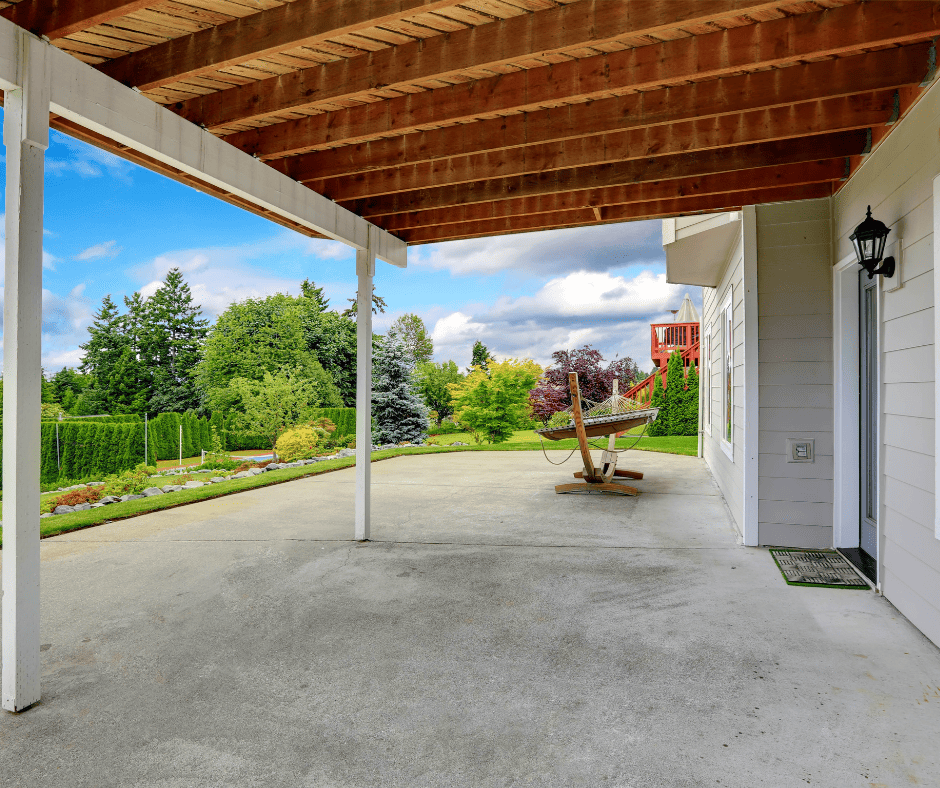
A concrete patio can be a practical choice when a homeowner wants a continuous surface, flexible finish options, and a lower initial investment than many premium paver or natural-stone installations.
Concrete also has important limitations. Some cracking should be expected over time, repairs can remain visible, and successful performance in Pennsylvania depends heavily on the concrete mixture, site preparation, drainage, joints, placement, finishing, curing, and winter maintenance.
Concrete is not automatically a short-lived material, and pavers are not automatically problem-free. The best option depends on the property, budget, appearance, repair expectations, and complete installation plan.
Kelly Masonry helps homeowners compare materials through our patio design and installation services.
Concrete Patios at a Glance
| Question | Direct answer |
|---|---|
| Is concrete less expensive than pavers? | Plain concrete often has a lower initial cost, although decorative finishes, access, drainage, demolition, and site preparation can narrow the difference. |
| Will a concrete patio crack? | Some cracking is possible even with good design and construction. Joints and other practices help control where cracks occur and how they perform. |
| Is concrete suitable for Pennsylvania winters? | Yes, when the mixture and installation are designed for freeze-thaw exposure and the patio drains correctly. |
| Does reinforcement prevent cracks? | No. Reinforcement can help control crack width but does not eliminate cracking. |
| Does concrete need control joints? | Most slabs require a planned joint layout to manage shrinkage and movement. |
| Does concrete need to be sealed? | Not always. Sealing depends on the finish, exposure, stain risk, appearance goals, and selected product. |
| Can cracked concrete be repaired? | Often, but the correct repair depends on the cause, movement, crack condition, settlement, and desired appearance. |
| Is concrete better than pavers? | Neither is universally better. Concrete may cost less initially, while pavers are generally easier to repair one unit at a time. |
What Is a Concrete Patio?
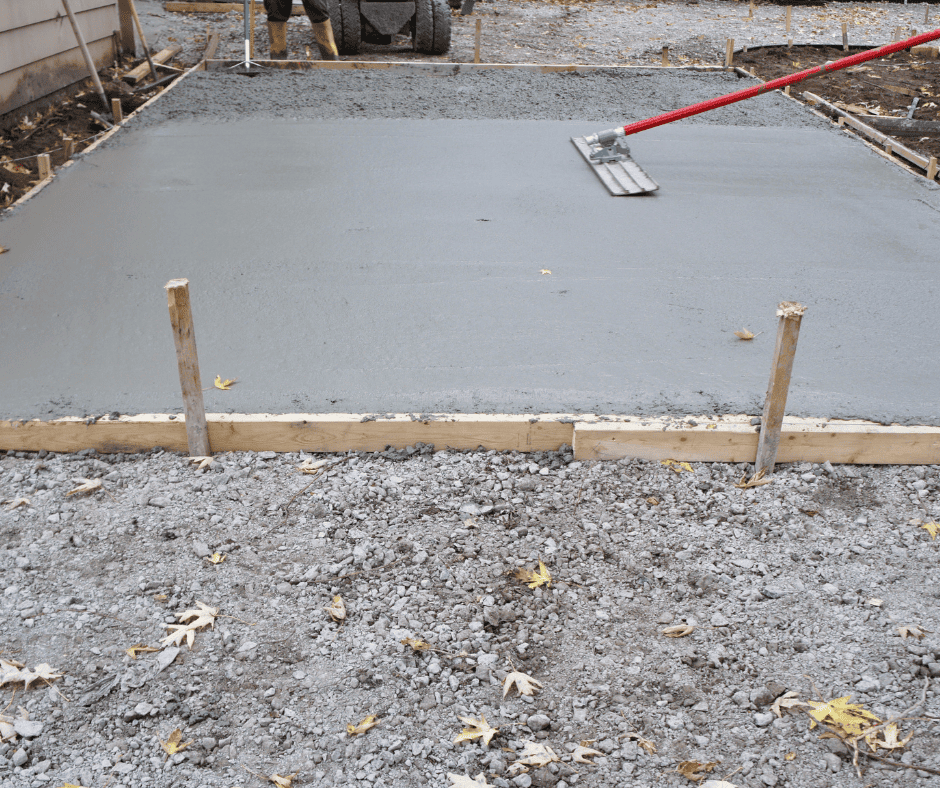
A concrete patio is a slab-on-ground outdoor surface made from concrete placed within forms and finished to create a usable entertaining, dining, or walking area.
Concrete is made from cementitious material, water, fine aggregate, coarse aggregate, and sometimes admixtures or fibers. Cement is one ingredient in concrete; the words are not interchangeable.
Concrete patios may have several finishes:
- Broom-finished concrete
- Smooth or lightly textured concrete
- Colored concrete
- Stamped concrete
- Exposed-aggregate concrete
- Saw-cut decorative patterns
- Borders or combinations with brick, stone, or pavers
The finish changes the appearance and maintenance requirements, but the patio’s performance still depends on the complete slab and site preparation.
Advantages of a Concrete Patio
1. Lower initial cost for a simple design
Plain poured concrete commonly requires less individual material fitting than brick, natural stone, or modular pavers.
A basic rectangular slab with straightforward access and a broom finish may therefore cost less initially than a detailed paver or flagstone patio.
The price advantage can decrease when the project includes:
- Stamping
- Integral or surface color
- Multiple pours
- Decorative borders
- Complex curves
- Steps
- Walls
- Difficult access
- Demolition
- Extensive drainage
- Specialty sealers
Compare complete proposals rather than surface-material prices alone.
2. Continuous surface
Concrete creates a relatively continuous surface with no sand-filled joints between individual paving units.
This can make it easier to move:
- Dining chairs
- Carts
- Grills
- Some mobility equipment
- Small wheeled items
Surface texture, slope, joints, transitions, and changes in elevation must still be designed carefully.
3. Multiple finish options
Concrete does not have to be plain gray.
Homeowners can consider:
- Broom texture
- Integral color
- Staining
- Exposed aggregate
- Stamped patterns
- Decorative saw cuts
- Contrasting borders
Request physical samples and completed-project photographs. Color and texture can look different outdoors, after curing, when wet, and after a sealer is applied.
4. Efficient installation for simple layouts
Once excavation, forms, base preparation, utilities, drainage, and reinforcement are complete, a simple slab can often be placed as one coordinated operation.
Concrete still requires appropriate finishing, jointing, protection, and curing after placement. Fast placement should not be confused with an immediately finished or fully cured patio.
5. Suitable for many outdoor uses
Concrete can be used for:
- Dining patios
- Grill areas
- Walkways
- Landings
- Outdoor-kitchen foundations
- Utility areas
- Selected pool-adjacent surfaces
- Bases for later masonry finishes
The slab design may change when it supports heavy appliances, walls, fireplaces, hot tubs, columns, or other concentrated loads.
Disadvantages of a Concrete Patio
1. Cracking can occur
Concrete changes volume as it loses moisture and experiences temperature changes. It can also respond to settlement, restraint, loads, and movement in the supporting soil.
The American Concrete Institute explains that completely crack-free slabs are not a realistic expectation, even when modern design and construction practices are followed.
The goal is to reduce uncontrolled cracking and manage where it occurs.
2. Repairs may remain visible
Concrete color and texture change as a surface cures, weathers, and becomes exposed to sunlight and use.
A repair material may not match the existing slab exactly. The visibility of a repair depends on:
- Crack size
- Repair method
- Surface finish
- Concrete color
- Age
- Weathering
- Previous coatings or sealers
A visible repair is not necessarily a failed repair, but homeowners should understand the aesthetic limitation.
3. Localized replacement is more difficult
Individual pavers can often be lifted and replaced. A concrete slab is continuous, so correcting settlement or widespread deterioration may require:
- Crack repair
- Slab lifting
- Resurfacing
- Saw-cut partial replacement
- Demolition and replacement of a larger section
The best method depends on the underlying cause.
4. Decorative finishes can require additional care
Stamped or colored concrete may require more careful cleaning and maintenance than plain broom-finished concrete.
A decorative sealer may change:
- Color
- Sheen
- Traction
- Stain resistance
- Maintenance frequency
An unsuitable product or poor application can create an uneven or slippery appearance.
5. Installation conditions matter
Concrete placement is sensitive to weather, temperature, wind, moisture loss, finishing timing, and curing.
A good mixture can still perform poorly if water is added improperly at the jobsite, the surface is overworked, joints are late, or curing is inadequate.
Why Does Concrete Crack?
Concrete patio cracking may have more than one cause.
The National Ready Mixed Concrete Association’s guide to concrete cracking identifies factors including movement, restraint, settlement, freeze-thaw exposure, improper jointing, and inadequate curing.
Drying shrinkage
Concrete normally contracts as moisture is lost. When the slab cannot move freely, tensile stress can lead to cracking.
Improper or missing joints
A slab without an appropriate joint layout may crack at uncontrolled locations.
Settlement
Weak, poorly compacted, disturbed, or eroded supporting material can allow parts of the slab to settle.
Restraint
Walls, steps, columns, foundations, and other structures can prevent a slab from moving independently.
Freeze-thaw exposure
Moisture inside vulnerable concrete can freeze and contribute to internal damage or surface scaling.
Rapid surface drying
Hot, dry, or windy conditions can cause the surface of fresh concrete to lose moisture too quickly and develop plastic-shrinkage cracks.
Excess water or unsuitable finishing
Changing the concrete mixture or finishing a surface while bleed water is present can affect strength and durability.
Loads not considered in the design
Hot tubs, walls, fireplaces, vehicle traffic, heavy outdoor kitchens, and other concentrated loads may require a different slab design.
Does All Concrete Crack?
Some cracking should be anticipated, but that does not mean every concrete patio will develop major or unacceptable damage.
A properly designed patio uses construction practices intended to:
- Reduce random cracking
- Control crack locations
- Limit crack width
- Protect the surface
- Manage water
- Support the expected loads
A narrow crack located within a planned joint is different from a displaced crack that creates a trip hazard or indicates settlement.
Avoid promises that a patio will never crack. Also avoid assuming that every visible hairline crack means the slab has failed.
Control Joints vs. Isolation Joints
Different joints perform different jobs.
The NRMCA guide to joints in concrete slabs describes joints as planned locations that help concrete accommodate movement.
Contraction or control joints
Contraction joints create planned weakened locations where shrinkage cracking is intended to occur.
They may be formed, tooled, or saw-cut according to the slab design and construction method.
Isolation joints
Isolation joints separate the patio from structures or elements such as:
- House foundations
- Columns
- Steps
- Walls
- Existing slabs
- Other fixed restraints
They allow adjoining components to move more independently.
Expansion joints
The phrase “expansion joint” is often used broadly, but not every visible joint in a patio is an expansion joint. The contractor should explain the purpose and material of each joint in the plan.
Joint spacing, depth, timing, and layout should be designed for the slab rather than selected from one universal rule.
Does Rebar or Fiber Stop Concrete From Cracking?
No reinforcement system guarantees crack-free concrete.
Depending on the design, reinforcement may include:
- Welded wire reinforcement
- Steel reinforcing bars
- Synthetic fibers
- Other engineered reinforcement
Reinforcement may help hold cracks tighter or improve specific performance characteristics. It does not replace:
- Proper subgrade support
- Suitable slab thickness
- Correct concrete mixture
- Planned joints
- Drainage
- Placement
- Finishing
- Curing
Ask the contractor to explain the purpose, location, support, and design of the proposed reinforcement.
How Does Pennsylvania Weather Affect Concrete?
Pennsylvania patios are exposed to repeated wetting, freezing, snow, ice, and deicing materials.
Concrete intended for freeze-thaw exposure should use a suitable mixture and air-void system. Entrained air provides small internal spaces that help relieve pressure when moisture freezes.
The American Cement Association’s concrete guidance explains how air entrainment improves resistance to freezing and thawing.
Performance also depends on:
- Water-cementitious-material ratio
- Aggregate suitability
- Air content
- Drainage
- Finishing
- Curing
- Surface saturation
- Deicing exposure
Do not evaluate winter durability from the word “concrete” alone. Ask what concrete specification will be used for the actual patio.
Why Curing Matters
Curing maintains the moisture and temperature conditions that allow freshly placed concrete to develop its intended properties.
The American Concrete Institute’s curing guidance explains that moisture and temperature control support strength development, reduce permeability, and limit adverse volume changes.
Curing may involve:
- Moisture-retaining coverings
- Water curing
- Curing compounds
- Other approved methods
The correct process depends on the mixture, weather, finish, and project specifications.
A patio should also remain protected from traffic and loads for the period required by the contractor and concrete supplier.
How Important Is Drainage?
Drainage is essential for concrete, pavers, brick, and natural-stone patios.
A concrete surface should be designed so water moves toward an appropriate outlet rather than:
- Collecting in low spots
- Flowing toward the home
- Saturating the slab edge
- Eroding the supporting soil
- Freezing repeatedly in cracks and depressions
Drainage planning may include:
- Surface pitch
- Grading
- Downspout management
- Channel or area drains
- Swales
- Underground piping
- Connections to an approved outlet
- Coordination with nearby walls and landscaping
Read our guide to patio drainage requirements in Delaware County and the Main Line.
Standard paver joints should not be described as a drainage system. A patio designed for infiltration requires a complete permeable-paving assembly.
Concrete Patio Finish Options
| Finish | Appearance | Important considerations |
|---|---|---|
| Broom finish | Uniform texture with visible broom lines | Practical and commonly selected for exterior traction |
| Smooth or lightly textured | Cleaner, more refined surface | Excessively smooth finishes may provide less traction when wet |
| Integral color | Color added throughout the concrete mixture | Final color can vary with mixture, curing, weather, and finishing |
| Surface-applied color | Color applied near or after placement | Wear and maintenance depend on the selected system |
| Stamped concrete | Patterned to resemble stone, brick, tile, or wood | Requires skilled timing, release materials, color planning, and maintenance |
| Exposed aggregate | Aggregate intentionally revealed at the surface | Texture and comfort depend on aggregate size and finishing |
| Decorative saw cuts | Lines cut to create visual patterns | Decorative cuts must be coordinated with functional joints |
Create a sample panel when color, pattern, texture, or sealer appearance is important.
Stamped Concrete: Additional Pros and Cons
Stamped concrete can create a more decorative surface than plain concrete.
Possible advantages
- Broad range of patterns
- Custom colors
- Continuous surface
- Can resemble brick, stone, or tile
- May cost less than some premium natural-stone installations
Possible disadvantages
- The slab can still crack
- Repair matching can be difficult
- Color may weather unevenly
- Decorative sealers may require maintenance
- Some finishes can become slippery when wet
- Pattern depth can affect furniture and walking comfort
Stamped concrete should be selected for its appearance—not because stamping prevents cracking or winter damage.
How Much Does a Concrete Patio Cost?
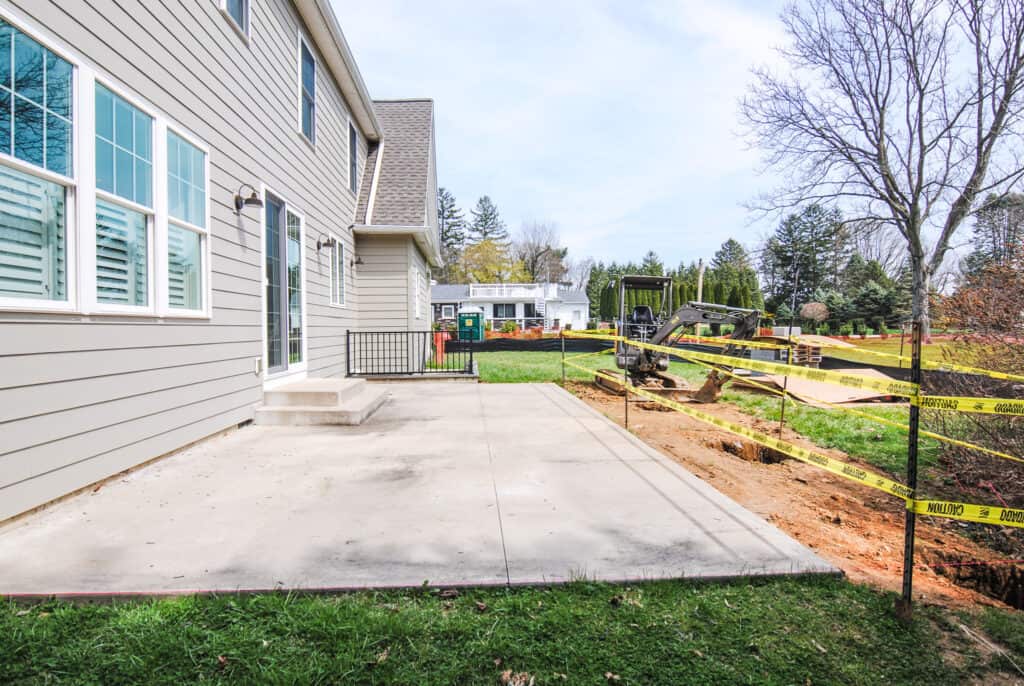
Kelly Masonry currently publishes these general patio-project planning ranges:
| Patio level | Kelly Masonry planning range |
|---|---|
| Basic patio | Around $20,000 |
| Average patio | Around $40,000 |
| High-end custom patio | $60,000+ |
These are complete patio-project ranges and are not concrete-only prices.
Concrete often trends toward the lower side when the project has:
- A simple shape
- Plain finish
- Easy access
- Limited demolition
- Minimal grade changes
- No major built-in features
The price may increase because of:
- Patio size
- Stamping or color
- Demolition
- Difficult access
- Drainage
- Steps
- Walls
- Thickened areas
- Reinforcement
- Outdoor kitchens
- Fire features
- Multiple concrete placements
- Landscaping restoration
Review our complete patio installation cost guide or use the Kelly Masonry project pricing calculator for initial planning.
An on-site evaluation is required before an exact proposal can be prepared.
Concrete vs. Pavers
| Factor | Concrete patio | Interlocking paver patio |
|---|---|---|
| Initial cost | Plain concrete may begin lower | Often higher because of materials and individual-unit installation |
| Surface | Continuous slab with planned joints | Individual paving units with joints |
| Cracking | Some cracking is possible | Individual units may crack, settle, spread, or move |
| Repair | Repairs can remain visible | Individual units can often be lifted and replaced |
| Design | Plain, colored, stamped, exposed aggregate, or decorative cuts | Broad range of unit sizes, colors, textures, and patterns |
| Drainage | Depends on pitch and drainage design | Standard systems depend on pitch; permeable systems require specialized construction |
| Maintenance | Cleaning, joint and crack monitoring, and optional sealing | Cleaning, joint maintenance, resetting, and optional sealing |
| Winter performance | Depends on mixture, air entrainment, curing, drainage, and exposure | Depends on product, base, drainage, joints, edge restraints, and maintenance |
Neither material is maintenance-free.
Read our detailed paver patios versus concrete comparison for a side-by-side decision guide.
Can a Cracked Concrete Patio Be Repaired?
Many concrete patios can be repaired, but the cause should be identified first.
Possible options include:
Crack filling or sealing
May be appropriate for selected stable cracks where the goal is to limit water and debris entry.
Cosmetic surface repair
Small surface defects may be repaired with a compatible material, although the color and texture may remain visible.
Slab lifting
Some settled slabs can be lifted when the concrete remains sufficiently intact and the method is suitable for the site.
Partial replacement
A damaged section may be saw-cut, removed, and replaced. The new concrete may not match the original slab exactly.
Resurfacing
Some structurally stable slabs can receive a compatible resurfacing system after proper preparation.
Full replacement
Replacement may be more appropriate when:
- Settlement is widespread
- Drainage is fundamentally wrong
- The slab is extensively cracked or displaced
- Surface deterioration is severe
- The patio elevation no longer works
- The layout no longer meets the homeowner’s needs
Use our guide to patio repair versus replacement to evaluate the broader decision.
Kelly Masonry also provides patio and walkway repair services.
Does a Concrete Patio Need to Be Sealed?
Not every concrete patio requires a sealer.
A sealer may be considered for:
- Decorative appearance
- Color enhancement
- Certain stain exposures
- Selected moisture or chemical exposure
- Maintenance of a stamped or colored finish
Possible disadvantages include:
- Changed color
- Added sheen
- Uneven appearance
- Reduced wet traction
- Peeling or whitening with an unsuitable product
- Ongoing reapplication
Before sealing:
- Identify the concrete finish.
- Determine whether an existing coating is present.
- Confirm compatibility with the concrete and previous products.
- Allow the required curing period.
- Correct moisture and drainage problems.
- Test a small area.
- Follow the product instructions.
Do not promise that a sealer will prevent structural cracks or correct a failed base.
How Do You Maintain a Concrete Patio?
Routine maintenance may include:
- Sweeping away leaves and soil
- Keeping drainage paths clear
- Cleaning spills using concrete-compatible products
- Monitoring cracks and joints
- Removing snow carefully
- Avoiding unapproved deicing materials
- Inspecting settlement and low spots
- Reviewing decorative sealer condition
- Correcting drainage problems promptly
Do not use aggressive cleaning methods without considering the finish, age, sealer, and surface condition.
Questions to Ask a Concrete Patio Contractor
Ask:
- What concrete mixture is specified for freeze-thaw exposure?
- How will air content be verified?
- How will the area be excavated and supported?
- What slab thickness is proposed, and why?
- What reinforcement is included?
- Where will contraction and isolation joints be placed?
- How will water drain from the surface?
- How will the concrete be cured?
- What weather conditions could delay placement?
- When can the patio receive foot traffic, furniture, and heavy loads?
- What finish and sealer are included?
- What cracking should the homeowner reasonably expect?
- What workmanship warranty applies?
- How will decorative color or pattern variations be handled?
- What is excluded from the proposal?
Read about Kelly Masonry’s project process before scheduling your consultation.
Add photographs showing:
- Existing conditions
- Excavation and base preparation
- Forms and reinforcement
- Concrete placement
- Joint layout
- Curing
- Completed surface
- The patio after at least one winter, when available
Frequently Asked Questions
Are concrete patios a good investment?
Concrete can be a good choice when lower initial cost, a continuous surface, and flexible finish options are priorities. The value depends on design, construction, maintenance, and how well concrete patios are a good investment.
Concrete can be a good choice when the material fits the homeowner’s needs.
Will every concrete patio crack?
Some cracking is possible even with good construction. Planned joints, suitable materials, proper placement, drainage, and curing help reduce and control random cracking.
Is concrete suitable for Pennsylvania winters?
Yes. The concrete mixture, air entrainment, aggregate, drainage, finishing, curing, and winter maintenance must be appropriate for freeze-thaw exposure.
How long does a concrete patio last?
There is no universal lifespan. Performance depends on the mixture, site preparation, slab design, drainage, curing, exposure, loads, maintenance, and repair history.
Is stamped concrete more durable than plain concrete?
Stamping changes the surface appearance. It does not remove the slab’s need for proper mixture design, joints, curing, drainage, and maintenance.
Does stamped concrete crack?
Yes, stamped concrete can crack because it is still a concrete slab. Joint placement and construction practices help manage cracking.
Does reinforcement stop a concrete patio from cracking?
No. Reinforcement may control crack width or provide other design benefits, but it does not guarantee a crack-free slab.
How thick should a concrete patio be?
The correct thickness depends on the anticipated loads, soil, support, slab design, and local requirements. A patio supporting heavy features may require a different design from a pedestrian-only slab.
Is concrete slippery?
Traction depends on the surface finish, slope, water, contaminants, wear, and sealer. Exterior finishes should be selected for their intended exposure.
Does concrete need to be sealed?
Not always. Sealing is a finish- and exposure-specific decision rather than a universal structural requirement.
Can concrete be installed over an old patio?
Sometimes, but the existing slab, elevation, drainage, cracks, movement, and proposed system must be evaluated. Covering a moving or poorly drained slab can transfer problems into the new surface.
Are pavers always better than concrete?
No. Pavers generally offer easier unit-by-unit repair and broader modular design choices. Concrete may provide a lower initial cost and continuous surface. The better option depends on the project.
How soon can a new concrete patio be used?
The schedule depends on the concrete mixture, weather, curing, finish, and expected load. Follow the contractor and concrete supplier’s project-specific instructions.
About the Author
John Kelly is the founder of Kelly Masonry and has more than 25 years of masonry and outdoor-living experience. His team designs, installs, maintains, and repairs concrete, paver, brick, flagstone, and natural-stone patios throughout Delaware County, the Main Line, and surrounding Pennsylvania communities.
Reviewed by: John Kelly
Last updated: July 30, 2026
Considering a Concrete, Paver, or Natural-Stone Patio?
Kelly Masonry can evaluate your property, drainage, access, design goals, material preferences, and budget before recommending a patio system.
Explore our patio installation services, compare pavers and natural stone, browse our outdoor-living portfolio, or request a consultation.