If your patio is sinking, cracking, holding water, growing weeds, or developing loose stones, the visible damage doesn’t always tell you what’s actually wrong.
A patio problem can start at the surface, but it can also involve the bedding, foundation, soil, drainage, joints, edges, or surrounding property.
That’s why diagnosis matters.
Resetting one paver won’t necessarily solve a recurring settlement problem. Filling a crack won’t correct movement underneath it. And adding a drain won’t automatically fix a patio with incorrect elevations.
This guide will help you identify what the symptoms may be telling you and where to look next.
If you already know your patio needs professional attention, Kelly Masonry provides patio and walkway repair throughout Delaware County and the Main Line.
Common Patio Problems at a Glance
| What you see | What it could indicate | Learn more |
| Sinking pavers | Bedding, base, soil, water, or settlement | Sinking paver guide |
| Standing water | Low spots, pitch, settlement, grade, or drainage | Patio drainage guide |
| Cracks | Material-specific cracking, movement, or settlement | Cracking/concrete guide |
| Loose or rocking stones | Support, setting material, joints, or movement | Professional evaluation |
| Weeds throughout joints | Organic material, open joints, or joint deterioration | Polymeric sand guide |
| Moving patio edges | Edge support, base, or surrounding grade | Professional evaluation |
| Multiple recurring problems | Broader foundation, drainage, or installation issue | Repair vs. replacement guide |
The same symptom can have several causes, so this table should be used as a starting point rather than a diagnosis.
1. Patio Pavers Are Sinking
One of the most common patio complaints is an area that no longer sits at the same elevation as the surrounding surface.
You may notice:
- One sunken paver
- A low spot across several pavers
- An entire corner settling
- A depression that holds water
- A transition that has become uneven
These situations should not automatically be treated as the same problem.
Sinking can potentially involve conditions in the:
- Bedding layer
- Base
- Supporting soil
- Drainage
- Edges
- Previously disturbed areas
The pattern matters.
One isolated paver behaves differently from an entire section of patio that is moving in the same direction.
If a sunken area has already been reset and continues to move, it is particularly important to look beyond the surface.
For a deeper explanation, read Why Patio Pavers Sink and How to Fix Them.
2. Water Is Pooling on the Patio
Standing water is another symptom that deserves investigation.
After rainfall, look at:
- Where the water enters the area
- Where it travels
- Where it collects
- How long it remains
- Whether the problem is new
- Whether nearby landscaping or hardscape has changed
Potential contributing factors can include:
- Localized low spots
- Settlement
- Surface pitch
- Surrounding grade
- Downspout discharge
- Drainage conditions
The important question isn’t simply:
“How do I get rid of this puddle?”
It’s:
“Why is water collecting here, and where should it go instead?”
Adding a drain without understanding the complete water path may not address the underlying issue.
For more detail, read Does Your Patio Need a Drainage System?.
3. Cracks Are Appearing
A “cracked patio” can mean several very different things.
The crack might be in:
- Poured concrete
- A concrete paver
- Flagstone
- Another natural stone
- A mortar joint
- An adjacent wall or step
Those are not interchangeable problems.
When looking at a crack, useful questions include:
- What material cracked?
- Where is the crack?
- Are the two sides still at the same elevation?
- Is the surrounding area moving?
- Is water present?
- Is the crack isolated or widespread?
- Has it changed over time?
A broken individual paver, for example, is a different situation from a concrete slab showing movement across a larger area.
For concrete-specific considerations, read The Pros and Cons of Concrete Patios.
4. Stones or Pavers Feel Loose or Rock When You Walk on Them
A patio surface should feel stable underfoot.
If individual stones or pavers rock, shift, or feel loose, the visible unit may not necessarily be the cause.
The condition can potentially involve:
- Bedding
- Setting material
- Joints
- Support beneath the surface
- Nearby movement
- Edges
Look at whether the problem is:
Isolated: One or two units move while everything around them remains stable.
Widespread: Multiple areas move, joints are opening, or elevations are changing.
That distinction can help determine whether the problem is localized or part of something larger.
Avoid assuming that adding joint material alone will stabilize a surface that is moving underneath.
5. Weeds Keep Growing Between the Pavers
Weeds between pavers don’t automatically mean the patio foundation has failed.
Seeds can germinate in dirt and organic material that accumulates near the surface.
However, repeated weed growth can also appear alongside:
- Low joint material
- Open joints
- Joint deterioration
- Paver movement
- Poor maintenance
The first step is to look at the condition of the joints and the patio surface rather than assuming weeds are growing upward through the entire patio foundation.
Polymeric jointing products can help stabilize appropriate joints, but they do not make a patio permanently weedproof.
For maintenance and diagnosis, read How to Keep Weeds From Growing in Polymeric Sand.
6. The Edges of the Patio Are Moving
Patio problems don’t always begin in the middle.
Look around the perimeter for:
- Pavers spreading apart
- Border movement
- Open joints
- Loose outer units
- Settlement along the lawn
- Changes where the patio meets another surface
The edge is part of the patio system.
Movement there may involve the edge condition itself, but the supporting base, adjacent soil, drainage, or surrounding grade may also need to be considered.
If the edge is repeatedly repaired and continues to move, that is a reason to look for a broader cause.
7. Several Patio Problems Keep Coming Back
One recurring problem deserves attention.
Several recurring problems deserve a broader evaluation.
For example, imagine a patio that has:
- A sinking corner
- Standing water
- Opening joints
- Loose edge pavers
Treating each symptom independently may miss the relationship between them.
There could be a shared issue involving:
- Drainage
- Settlement
- Foundation conditions
- Surrounding grade
- Installation
- Multiple factors working together
This is where diagnosing the patio as a system becomes especially important.
Rather than repeatedly repairing what is visible, evaluate why several areas are changing at the same time.
Is the Problem on the Surface or Underneath the Patio?
A useful first question is whether the problem appears limited to the finished material.
For example, one cracked paver surrounded by a stable patio may be primarily a surface issue.
But when you see:
- Multiple changing elevations
- Widespread settlement
- Recurring low areas
- Several loose sections
- Persistent drainage problems
- Repairs that repeatedly fail
there may be more to investigate beneath or around the patio.
The foundation itself consists of multiple components.
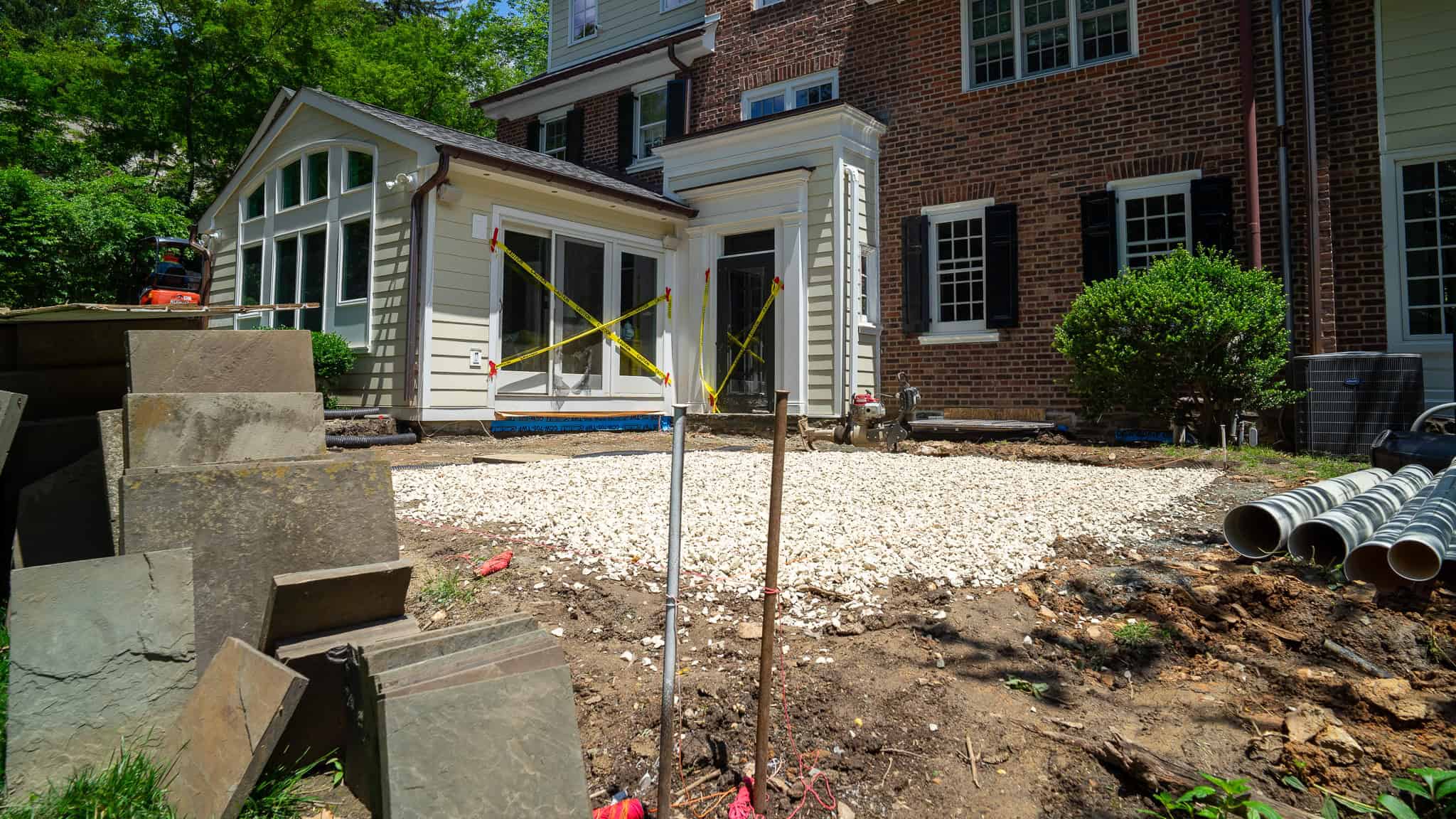
Our guide to patio base preparation explains what happens underneath a properly planned new patio and why those layers matter.
Could Downspouts Be Contributing to the Problem?
Sometimes water affecting a patio originates somewhere else.
Roof runoff can become relevant when a downspout discharges:
- Onto the patio
- Near its edge
- Into a low area
- Close to the house
- Into an area that does not drain effectively
When investigating a wet or settling patio, look beyond the patio itself.
Ask where water from the roof, lawn, neighboring hardscape, and higher parts of the property travels during heavy rain.
The patio is only one part of the property’s drainage system.
Why Does the Same Patio Repair Keep Failing?
A recurring repair can be an important clue.
If the same pavers are reset repeatedly, the same joint cracks again, or the same low spot returns, the repair may have addressed the symptom without correcting whatever is causing it.
That doesn’t automatically mean the entire patio needs replacement.
It means the next evaluation should ask:
Why is this happening again?
That question can prevent a cycle of repeatedly repairing the visible surface.
Does My Patio Need Repair or Replacement?
Not every damaged patio needs to be rebuilt.
And not every patio should continue receiving small repairs indefinitely.
The decision depends on factors such as:
- How much of the patio is affected
- Whether problems are localized or widespread
- Condition of the existing material
- Whether drainage needs to change
- Whether the underlying issue can be corrected locally
- Previous repairs
- Whether the current layout still works for you
Because this is a separate decision from diagnosing the initial problem, we’ve covered it in its own guide.
Read Patio Repair vs. Replacement for the factors to consider before deciding.
What Should You Look for When Inspecting Your Patio?
You don’t need to diagnose the construction yourself.
But you can gather useful information before calling a contractor.
Walk around the patio and note:
- Where the problem occurs
- Whether it is isolated or widespread
- When you first noticed it
- Whether it has changed
- What happens during heavy rain
- Where nearby downspouts discharge
- Whether adjacent landscaping has changed
- Whether the same area has been repaired before
- Whether steps, walls, or walkways are also moving
- Whether the patio still drains the way it used to
Photos taken over time can also help show whether a condition is changing.
This information gives the contractor a much better starting point than simply saying, “My patio is broken.”
What Should a Patio Evaluation Look At?
The evaluation should go beyond the most obvious damaged paver or crack.
Depending on the symptoms, relevant conditions may include:
- Finished surface
- Joints
- Edges
- Elevations
- Drainage
- Downspouts
- Surrounding grade
- Steps
- Walls
- Adjacent walkways
- Evidence of settlement
- Previous repairs
The goal is to understand what is happening before deciding how much work is actually necessary.
Frequently Asked Questions
What are the most common patio problems?
Common problems include sinking pavers, standing water, cracks, loose stones or pavers, deteriorated joints, moving edges, and recurring settlement.
Why is my patio sinking?
Several conditions can contribute to patio settlement, including issues involving the bedding, base, supporting soil, water, edges, or previously disturbed areas. The pattern of settlement should be evaluated before deciding on a repair.
Why does my patio hold water after rain?
Standing water can be related to low areas, settlement, surface pitch, surrounding grades, downspouts, or other drainage conditions.
Why are my patio pavers loose?
Loose pavers can involve the bedding, joints, edges, support beneath the surface, or movement elsewhere in the patio.
Are cracks in a patio always serious?
No. The significance depends on the material, crack location, surrounding movement, elevation changes, and whether the condition is changing.
Why do weeds keep growing between my pavers?
Seeds can grow in dirt and organic material that accumulates in the joints. Low, deteriorated, or open joint material can also make weed growth more noticeable.
Why does my patio repair keep failing?
If the same problem repeatedly returns, the previous repair may not have addressed the condition causing the symptom. A broader evaluation may be appropriate.
Can patio drainage problems cause settlement?
Water can contribute to conditions such as erosion, washout, saturated soil, and movement. The patio and surrounding property should be evaluated together when drainage and settlement occur in the same area.
Should I repair or replace my patio?
Localized problems may be repairable, while widespread or recurring issues may require more extensive work. The decision should be based on the patio’s overall condition and the cause of the damage.
About the Author
John Kelly is the founder of Kelly Masonry. Since 2002, Kelly Masonry has installed and repaired patios, walkways, masonry, and outdoor-living spaces throughout Delaware County, the Main Line, and surrounding Pennsylvania communities.
Published: August 2026
Reviewed by: John Kelly
Having Problems With Your Patio?
If your patio is sinking, cracking, holding water, or moving, the first step is figuring out why.
Kelly Masonry can evaluate the visible problem along with the drainage, grade, surrounding conditions, and patio construction before recommending the appropriate next step.
Explore our patio and walkway repair services, learn why patio pavers sink, read our patio drainage guide, compare patio repair vs. replacement, browse our completed projects, or request a consultation.